
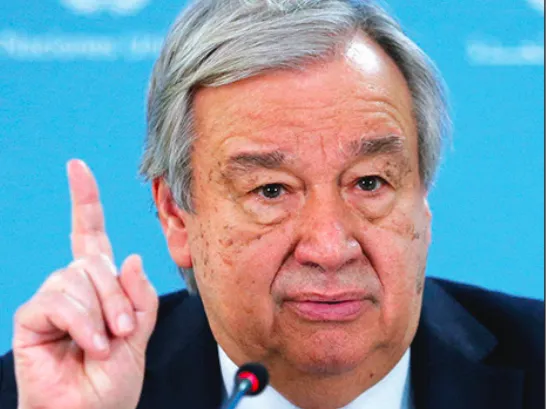
UN Chief Antonio Guterres Advocates for Multi-Polarity in Global Relations
United Nations Secretary-General Antonio Guterres highlighted the importance of supporting “multi-polarity” in global affairs, emphasizing the need for a diverse network of relationships among countries. In a press conference on January 30, 2026, Guterres referenced the Free Trade Agreement (FTA) between India and the European Union (EU) as a positive step towards achieving multi-polarity.
Guterres acknowledged the dominant positions of the United States and China in the current global landscape but emphasized the necessity of moving towards a more balanced and inclusive world order. He praised recent trade agreements such as the EU-Mercosur, EU-Indonesia, and EU-India FTAs, along with other international collaborations, as key elements in fostering a multipolar world conducive to the values outlined in the United Nations Charter.
On January 27, 2026, India and the EU finalized a groundbreaking free trade agreement, aiming to create a market of two billion people. The agreement, described as the “mother of all deals,” focuses on enhancing trade and defense cooperation to uphold the rules-based global order. Prime Minister Narendra Modi, European Commission President Ursula von der Leyen, and European Council President Antonio Costa unveiled a comprehensive five-year agenda during the summit talks.
Guterres stressed the importance of adapting global structures to reflect the evolving economic landscape, where emerging economies are gaining prominence. He cautioned against unilateral or dual-power dominance in addressing global challenges, emphasizing the need for collaborative partnerships in trade, technology, and international cooperation.
Challenges to International Peace and Security
In response to questions about alternative peace initiatives, such as the Board of Peace on Gaza proposed by U.S. President Donald Trump, Guterres reaffirmed the central role of the UN Security Council in maintaining international peace and security. He underscored the Security Council’s unique authority to make binding decisions on behalf of all member states, emphasizing the importance of reforming the Council to enhance its effectiveness.
Guterres highlighted the critical need for a reformed Security Council to address global conflicts and ensure compliance with international law. He noted that criticisms of the UN’s effectiveness are often linked to resistance towards Security Council reforms, which hinder the organization’s ability to act decisively on peace and security issues.
