
The Left’s Challenge: Reclaiming the Heart of the People
When Gorakh Pandey penned the lines, ‘Parson le aayi, barson le aayi, hardam akase takayi’ (It promised tomorrow, then promised years, always staring up at the sky), he was not just mocking a political agenda that continuously postpones justice and change while indulging in abstract dreams. He was highlighting the stark reality of everyday suffering that escalates on the ground.
Ironically, the Left echoed these very lines with fervor and pride, oblivious to the fact that the satire was directed towards them. Their version of socialism too had gradually become ‘slow,’ watered-down, delayed, and eventually detached from the populace it professed to serve.
Despite its shortcomings, the Left remains the sole credible faction that resonates with the most marginalized segments of society. However, it needs to break out of the confines of academia and communicate in the language of the common people. It must embody a political voice akin to Nekrasov, underscoring that ‘what life has taken away cannot be snatched by fate.’ Furthermore, it must rekindle the poetic essence of Marx, who countered the opening line of the Social Contract with the closing line of the Communist Manifesto: ‘We have nothing left to lose but our chains.’
This imperative becomes even more pronounced in a nation where the number of starving individuals surpasses that of half of Europe combined. The ‘Chingari’ (sparks of resistance) ignite when over 20,000 anonymous individuals perish in various urban centers, overlooked by the affluent. The Left possesses the haunting potency of Gogol’s dead souls, but to harness it effectively, it must champion dignity as vehemently as it does inequality. Poverty denotes material scarcity, while humiliation embodies a lived ordeal.
The surging Right in India capitalizes on comprehending this emotional landscape far more adeptly than the Left. It readily invokes primordial identities, forging a connection with the masses. The Left must acknowledge that people remain constant, only their circumstances evolve. Individuals who may be swayed for a monetary sum today could, under altered conditions, rebel against capitalist pretensions.
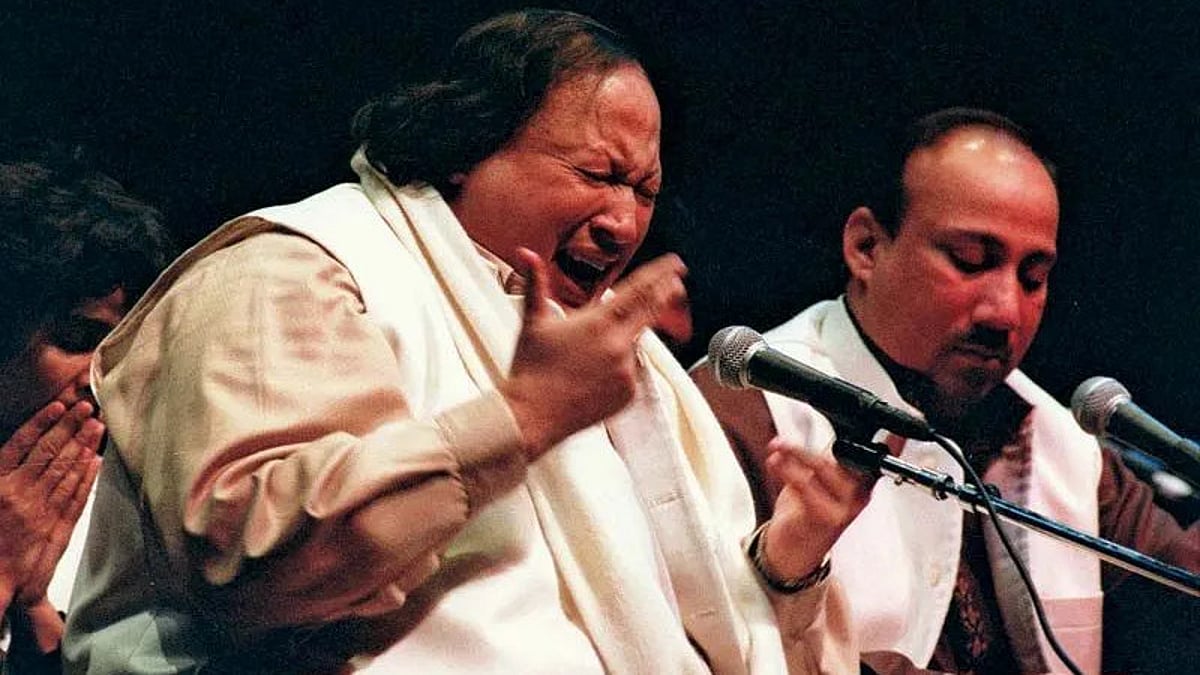
Nusrat’s couplet resonates deeply, encapsulating a truth that Indian politics shies away from confronting. Sometimes, the individuals you strive for do not align with your cause, and occasionally, your own ethos slips away unnoticed. However, this qawwali isn’t merely a lament.
Nusrat’s rendition is a reinvention in itself, blending ghazal and qawwali into a form that exudes Sufi essence and a palpable material sensibility. It harbors despair, yet it also embodies yearning. Longing often heralds the initial phase of rejuvenation.
For the Indian Left, the pivotal question is no longer whether the heart ever truly arrived. The crux lies in whether that heart can be reclaimed and whether the people it once professed to champion theoretically can now be embraced practically.
