
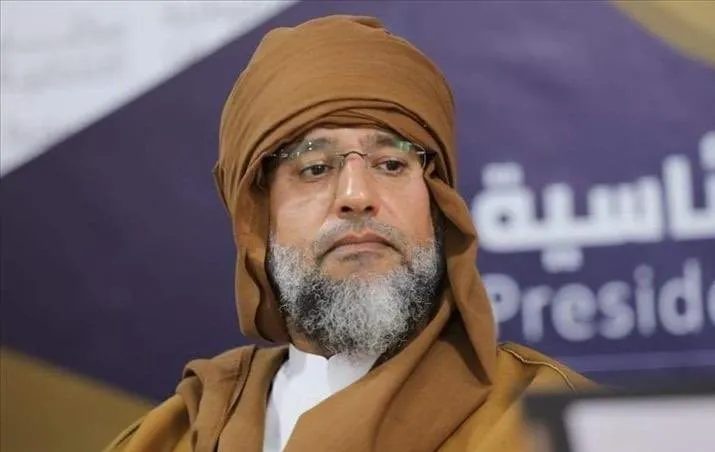
Seif al-Islam Gadhafi, Son of Former Libyan Dictator Moammar Gadhafi, Killed in Zintan
Cairo, Feb 04: In a tragic turn of events, Seif al-Islam Gadhafi, the son and once considered heir to Libya’s late dictator Moammar Gadhafi, met his demise in the town of Zintan, located 136 kilometers southwest of Tripoli, the capital city. The Libyan officials confirmed his death on Tuesday, revealing that the 53-year-old was fatally shot. The circumstances surrounding his killing remain shrouded in mystery, with an ongoing investigation by the Libyan chief prosecutor’s office.
Seif al-Islam’s lawyer, Khaled al-Zaidi, took to Facebook to announce his untimely death, while Abdullah Othman Abdurrahim, who represented Gadhafi in the U.N.-brokered political dialogue aiming to resolve Libya’s prolonged conflict, also confirmed the tragic news on social media.
According to a statement released by Seif al-Islam’s political team, the fatal incident involved “four masked men” who intruded his residence and carried out a “cowardly and treacherous assassination.” The statement further elaborated that Seif al-Islam engaged in a confrontation with the assailants, who resorted to disabling the CCTV cameras at the house in an attempt to cover up their malicious deeds.
Seif al-Islam, born in June 1972 in Tripoli, was the second son of the long-standing dictator Moammar Gadhafi. Known for his educational pursuits, Seif al-Islam pursued a Ph.D. at the London School of Economics and held the image of a reformist within the Gadhafi regime.
The downfall of the Gadhafi regime came in 2011 following a NATO-backed uprising that led to Moammar Gadhafi’s demise. The subsequent civil war left Libya in a state of turmoil, divided amongst conflicting armed factions and militias.
Seif al-Islam faced capture by fighters in Zintan towards the end of 2011 as he attempted to flee to Niger. After being granted amnesty by one of Libya’s rival governments, he was released in June 2017 and took refuge in Zintan.
In 2015, a Libyan court convicted Seif al-Islam of inciting violence and orchestrating the murder of protesters, sentencing him to death in absentia. Furthermore, he faced charges by the International Criminal Court for crimes against humanity related to the 2011 uprising.
Despite facing legal ramifications, Seif al-Islam made a controversial move in November 2021 by announcing his candidacy in Libya’s presidential election. However, his candidacy was subsequently disqualified by the country’s High National Elections Committee due to ongoing disputes between rival administrations and armed groups.
The political landscape in Libya remains tumultuous, with the shadow of the Gadhafi era continuing to influence the nation’s trajectory. The legacy of Seif al-Islam Gadhafi, marked by both promise and controversy, casts a long shadow over Libya’s turbulent journey towards stability and democracy.
