
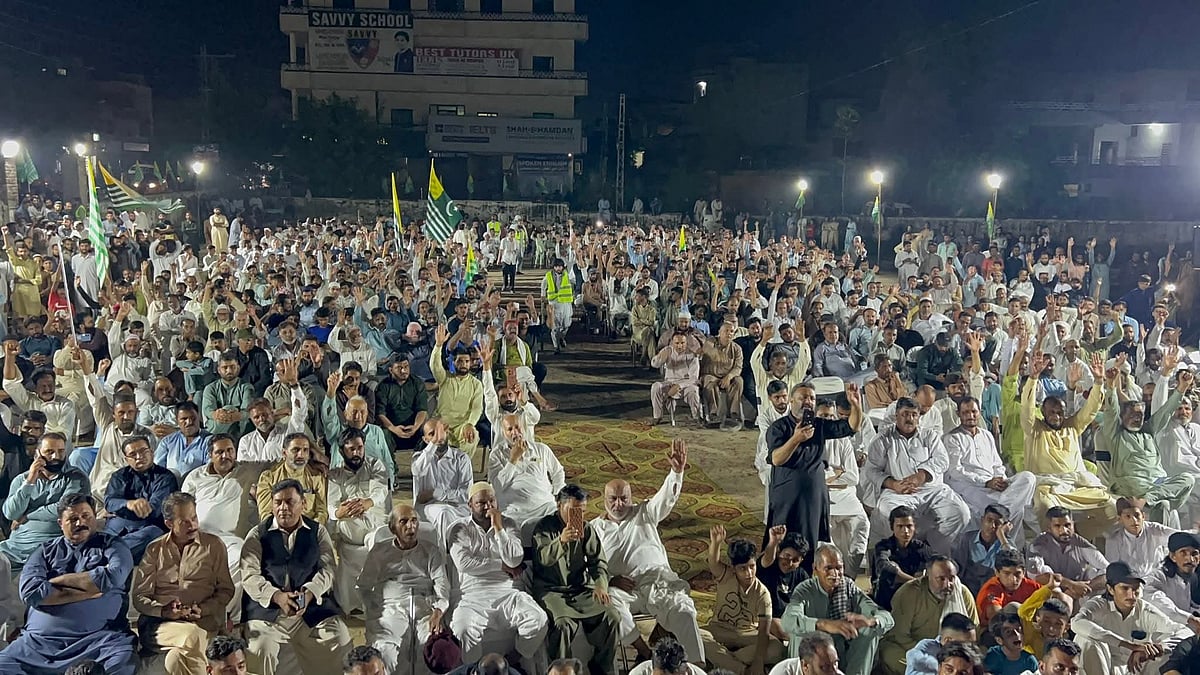
February 5, 2025 witnessed a significant event as a “Kashmir Solidarity and Al-Aqsa Storm Conference” took place in Rawalakot to commemorate Kashmir Solidarity Day. The event was shrouded in secrecy as media and social media were denied access, with only a few photographs and short video clips emerging later.
On the same day, Pakistan’s Prime Minister Shehbaz Sharif and Army Chief Gen. Asim Munir visited Muzaffarabad, addressing gatherings. The former Prime Minister of PaJK, Anwar ul Haq, emphasized the necessity of reviving jihad in his speech, a portion of which was later censored on Pakistan’s national media.
February 11 marked the joint commemoration of the death anniversary of Maqbool Butt by pro-independence parties.
The Pahalgam incident on April 22 led to the suspension of the Indus Waters Treaty, escalating tensions.
Subsequently, on May 7, India conducted airstrikes, triggering heavy and indiscriminate firing along the Line of Control, resulting in civilian casualties.
From May 7 to 10, firing continued along the Line of Control, leading to the tragic loss of 40 civilian lives as reported by the Inter-Services Public Relations.
A ceasefire was finally implemented on May 10, bringing temporary relief.
On May 24, a rally organized by the Awami Action Committee in Muzaffarabad expanded its demands to include the abolition of refugee seats in the Pakistan-administered Jammu and Kashmir Assembly.
May 27 witnessed a police encounter in Rawalakot, resulting in the death of four militants, including Zarnosh, and two police personnel.
The period from June to August saw no major public political developments officially reported.
September 16 saw parliamentary parties in Pakistan-administered Jammu and Kashmir alleging the use of an Indian “cipher” to destabilize the region, as revealed in a document presented by former Prime Minister Raja Farooq Haider.
Subsequently, on September 17, political parties announced plans for rallies in Rawalakot and Bagh.
On September 21, a rally in Rawalakot was attended by prominent political figures, including the sitting prime minister and former prime ministers, addressing the audience.
Following unsuccessful rallies, negotiations were initiated on September 23, leading to the deployment of security personnel and talks with the Awami Action Committee in Muzaffarabad.
Despite negotiations from September 24 to 25, no conclusive agreement was reached, prompting the movement of Pakistan’s security forces into various areas of Pakistan-administered Jammu and Kashmir.
On September 26, the local government imposed restrictions on mosque loudspeakers to prevent the broadcast of messages from the Awami Action Committee, coinciding with reports of social media shutdowns.
September 27 saw the announcement of a peace march by the Muslim Conference in Muzaffarabad, escalating tensions.
By September 28, a communications blackout was enforced across Pakistan-administered Jammu and Kashmir, suspending mobile phone networks and internet services.
September 29 witnessed protests, clashes, and violence in Muzaffarabad, leading to casualties and arrests, further intensifying the situation.
As protests spread on September 30, routes connecting Pakistan with Pakistan-administered Jammu and Kashmir were blocked, disrupting normalcy.
Efforts for dialogue were made on October 1, with Awami Action Committee leader Advocate Amjad Ali Khan briefly detained upon his return, amidst reports of clashes resulting in casualties.
Formal negotiations commenced on October 2, continuing over the next two days, culminating in an agreement on October 4 among the Awami Action Committee and the governments of Pakistan and Azad Jammu and Kashmir.
However, during this period, misinformation regarding the movement circulated in the Pakistani media, influencing public perception.
November 17 marked a political shift as a no-confidence motion led to Faisal Mumtaz Rathore assuming office as the new prime minister.
