
From Theory to Practice: Transforming Innovation Culture in Kashmir
Authored by Dr. Radhika Mia
In November 2025, an insightful article published by Kashmir News shed light on a critical issue: The 2025 Nobel Prize Sends a Warning to Kashmir Universities. The article emphasized the lack of emphasis on fostering creativity, experimentation, and technological thinking within Kashmir’s educational institutions.
While Kashmir boasts of producing intelligent graduates, the prevailing educational system discourages originality, innovation, and critical thinking. Students are often confined to rote memorization, classrooms prioritize conventional answers over creative thinking, and exams reward regurgitation over analytical reasoning.
Within such a rigid framework, the spirit of innovation finds it challenging to thrive.
The Nobel laureates in Economics for that year highlighted the significance of institutions that nurture novel ideas, experimentation, and technological advancements. They underscored that without adequate support for innovation, talent stagnates, hindering overall progress.
However, a visit to NexGen IEDC at the University of Kashmir presents a contrasting narrative. This innovation hub is quietly reshaping the landscape.
Under the astute leadership of Dr. Irfana Rashid, NexGen serves as a breeding ground for students and researchers to explore, fail, and learn through hands-on experiences. Dr. Rashid’s primary focus lies in creating an environment that fosters organic idea generation.
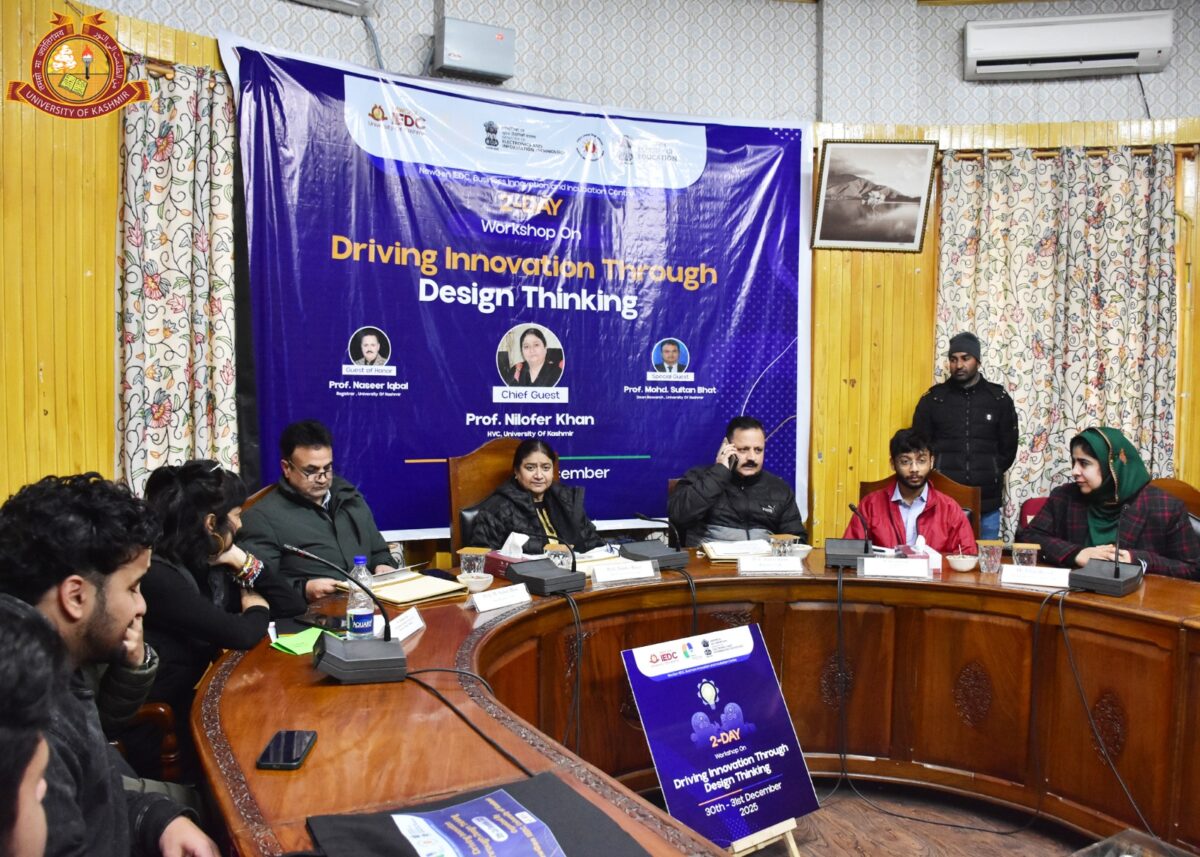
Supported by Er Abdul Rashid Bhat and the university administration, led by Vice Chancellor Prof. Nilofer Khan, NexGen exemplifies the essence of innovation requiring structured systems, patience, and a safe space for learning from mistakes.
The distinguishing factor observed at NexGen is the commitment to sincerity over mere ambition.
Encounters with student entrepreneurs and researchers engaged in tackling real-world challenges at varying stages revealed a spectrum of innovation. From nascent ideas to established startups, entities like Curve Electric, DreamCabs, EcoBuddy, and Switch Electric are carving paths in sectors like mobility, sustainability, and lithium-ion manufacturing.
Moreover, the emergence of deep-tech startups such as Ignition Dynamics underscores the pivotal role of supportive ecosystems like NexGen in propelling such ventures forward.
Kashmir stands to benefit from more initiatives akin to NexGen, with visionary leaders like Dr. Irfana driving the innovation narrative.
Entrepreneurship is on the rise in India, with a significant percentage of students expressing a desire to venture into business either immediately after graduation or within a few years. However, entrepreneurship goes beyond mere numbers; it embodies a culture of experimentation, resilience, and continuous learning—a facet often neglected by traditional educational systems.
The entrepreneurial landscape in Kashmir and many developing regions diverges from Western models, necessitating founders to navigate uncharted markets, build trust, and instill new consumption habits simultaneously.
As exemplified by Roland Fomundam of Greenhouse Ventures in Cameroon, the journey of entrepreneurship involves creating local demand and fostering market acceptance—often preceding the actual product development.
This process, though arduous and solitary, demands unwavering dedication, perseverance, and a steadfast focus. True innovation stems from such concerted efforts.
Amid global challenges in social, economic, and environmental spheres, Kashmir, with its intellectual reservoir and natural endowments, must transcend archaic educational paradigms.
NexGen embodies a paradigm shift in leadership, nurturing a culture that champions experimentation, embraces failure as a stepping stone to success, and prioritizes action over rote learning.
While breakthrough ideas hold significance, the ability to navigate uncertainties, doubts, and gradual progress is equally crucial. Students and entrepreneurs are encouraged to ponder: Does our solution address a genuine problem?
Subsequently, the journey entails the meticulous process of implementation, iteration, and persistence—sans guarantees.
The transformative initiatives unfolding at the University of Kashmir epitomize a rare phenomenon.
NexGen epitomizes the realm of possibilities when institutions evolve in a milieu often defined by its limitations.
It serves as a poignant reminder that innovation thrives when ideas intersect with support, and learners are entrusted to glean wisdom through practical experiences.
- The workshop on Design Thinking at the University of Kashmir was led by the author.
