
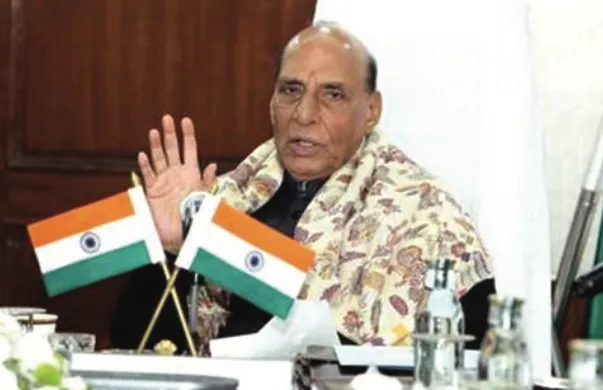
Alarming Trend of White-Collar Terrorism in India: Defence Minister Rajnath Singh
During the 104th foundation day event of Bhupal Nobles’ University in Udaipur, Defence Minister Rajnath Singh highlighted a concerning trend of white-collar terrorism in the country. Singh pointed out that highly-educated individuals are now engaging in anti-social and anti-national activities, posing a significant threat to society and national security.
One of the instances mentioned by Singh was the car bomb blast near the Red Fort in Delhi on November 10, where the perpetrators were revealed to be doctors. This revelation shed light on the disturbing reality of educated professionals turning towards terrorism.
Emphasizing the importance of values and character alongside knowledge, Singh stressed that education should not only lead to professional success but also contribute to the development of morality, ethics, and human character. He noted that the purpose of education goes beyond academic achievements and should encompass a holistic approach towards personal growth.
The incident involving the explosives-laden i20 car driven by Dr. Umar-un-Nabi outside the Red Fort underscored the presence of a ‘white-collar’ terror module. Subsequent investigations led to the arrests of three doctors – Muzammil Ganai, Adeel Rather, and Shaheena Saeed – among others, revealing the intricate web of educated individuals involved in criminal activities.
Singh further elaborated on the correlation between knowledge, competence, prosperity, and righteousness, highlighting the significance of a balanced education system that nurtures humility, character, and righteousness alongside academic knowledge. He emphasized that true happiness stems from righteousness and moral values.
Addressing the role of religion in education, Singh clarified that religion, in this context, refers to a sense of duty rather than mere religious practices. He warned against the dangers of education devoid of morality and ethics, which can lead to harmful consequences, as evidenced by the involvement of educated individuals in criminal acts.
While acknowledging the advancements in defence technology and the potential for India to achieve self-reliance in weapons production, Singh underscored the importance of utilizing technologies like artificial intelligence and machine learning for positive societal development. He envisioned India’s trajectory towards becoming the third-largest economy by 2030, with universities playing a pivotal role in this transformative journey.
Encouraging students to cultivate a broad perspective and avoid arrogance, Singh highlighted the significance of self-respect without crossing the line into egoistic behavior. He praised teachers as the pillars of education and emphasized the importance of values and humility in life.
As the world grapples with complex challenges such as environmental issues, health crises, and digital ethics, Singh stressed the need for a multidisciplinary approach to problem-solving. He urged universities to foster critical thinking skills among students and promote solution-driven research that can address real-world issues effectively.
Overall, Singh’s address underscored the evolving landscape of terrorism in India, the importance of character and values in education, and the crucial role of universities in shaping the future of the nation. His insights on wisdom, humility, and holistic thinking serve as valuable lessons for students and educators alike.
Chittorgarh MP C P Joshi, Nathdwara MLA Vishvaraj Singh, and other political leaders were also present at the event, highlighting the significance of collaborative efforts in driving positive change and progress in the country.
