
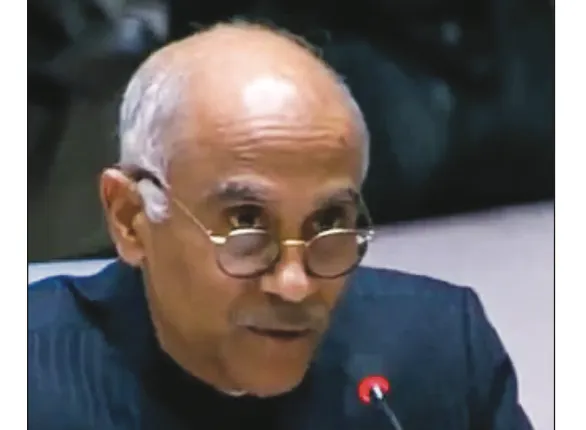
India strongly condemned Pakistan’s use of terrorism as a state policy during a recent United Nations Security Council debate. Ambassador Parvathaneni Harish delivered a sharp response to Pakistan’s Ambassador Asim Iftikhar Ahmad, who spoke about Operation Sindoor, Jammu and Kashmir, and the Indus Waters Treaty.
Harish emphasized that Pakistan’s agenda is solely focused on harming India and its people, rejecting Pakistan’s attempt to normalize terrorism. He reiterated that terrorism should never be accepted as a new normal and criticized Pakistan for its continued support of terrorism.
The Indian envoy debunked Pakistan’s account of Operation Sindoor, which was launched in retaliation for a terrorist attack that claimed the lives of 26 civilians in Pahalgam. Harish clarified that India’s actions were measured and aimed at dismantling terrorist infrastructure while highlighting the Security Council’s call for holding perpetrators of terrorism accountable.
Regarding Jammu and Kashmir, Harish asserted that Pakistan has no right to interfere in India’s internal matters, reaffirming the region’s integral status within India. He also addressed the Indus Waters Treaty, emphasizing India’s commitment to the agreement despite Pakistan’s history of violating it through wars and terror attacks.
India’s decision to suspend the treaty was a response to Pakistan’s ongoing support for terrorism, as highlighted by the Pahalgam attack. Harish urged Pakistan to end its backing of cross-border terrorism before the treaty could be reinstated.
In addition, Harish called out Pakistan’s lack of adherence to the rule of law, citing the 27th Constitutional Amendment that grants lifelong immunity to Pakistan’s Chief of Defence Forces. He urged Pakistan to reflect on its actions and uphold legal standards.
Overall, India’s stance at the UNSC debate emphasized the importance of combating terrorism and upholding international law, urging Pakistan to reconsider its support for terrorist activities.
