
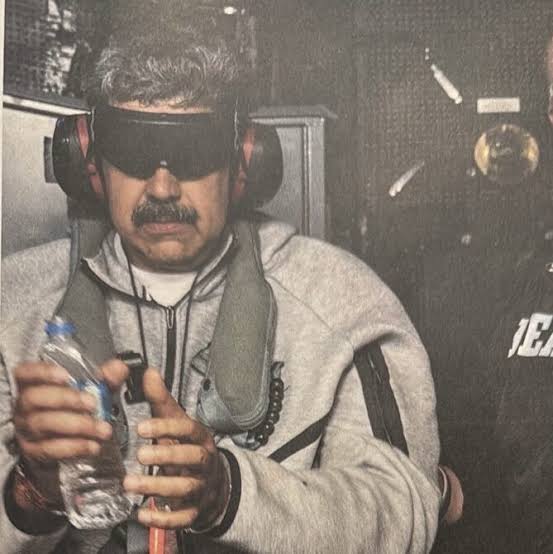
The Strategic Capture of Venezuelan President Nicolás Maduro
In recent events, the capture of Venezuelan President Nicolás Maduro has brought to light three significant themes that intersect in this geopolitical maneuver.
One of these themes revolves around the concept of Revolution in Military Affairs (RMA). This highlights the impressive military capabilities possessed by the United States, allowing for the swift and effective removal of Maduro without encountering significant resistance.
Comparatively, the takedown of Maduro can be likened to a decisive ‘knockout’ blow that neutralized Venezuela’s military strength.
Another theme at play is the alignment of the Venezuelan takeover with the US National Security document. This document, under the Trump administration, emphasized a focus on Latin America through the lens of the ‘Monroe Doctrine’.
The third theme underscores the central role of power in global politics and international relations. Despite the presence of international law, its efficacy remains limited in the face of power dynamics.
The capture of Maduro raises intriguing questions regarding the operational strategies employed. While advanced military technology plays a role, Human Intelligence (HUMINT) emerges as a critical factor in the success of such missions.
Reports suggest that a CIA team had been operating covertly in Venezuela since August 2025, primarily to monitor Maduro’s movements. However, the precise location of a high-profile target like Maduro is typically known only to individuals within his inner circle.
Furthermore, the absence of significant resistance in Venezuela following Maduro’s capture hints at a potential ‘softening up’ of key members within his regime, adding layers of complexity to the operation.
These tactical considerations aside, the broader implications of the US intervention in Venezuela extend to the geopolitical landscape of Latin America. The swift action taken by the US aligns with the principles outlined in the US National Security document, signaling a shift in the country’s sphere of influence.
While the Trump administration’s stance on ‘forever wars’ may limit extensive regime change efforts elsewhere, the strategic capture of Maduro serves as a potent demonstration of US power and intent in the region.
It is imperative for the global community to heed the underlying messages conveyed through these actions and the implications they hold for international relations moving forward.
Ultimately, the world must remain vigilant and attentive to the evolving dynamics of power and influence on the global stage.
