
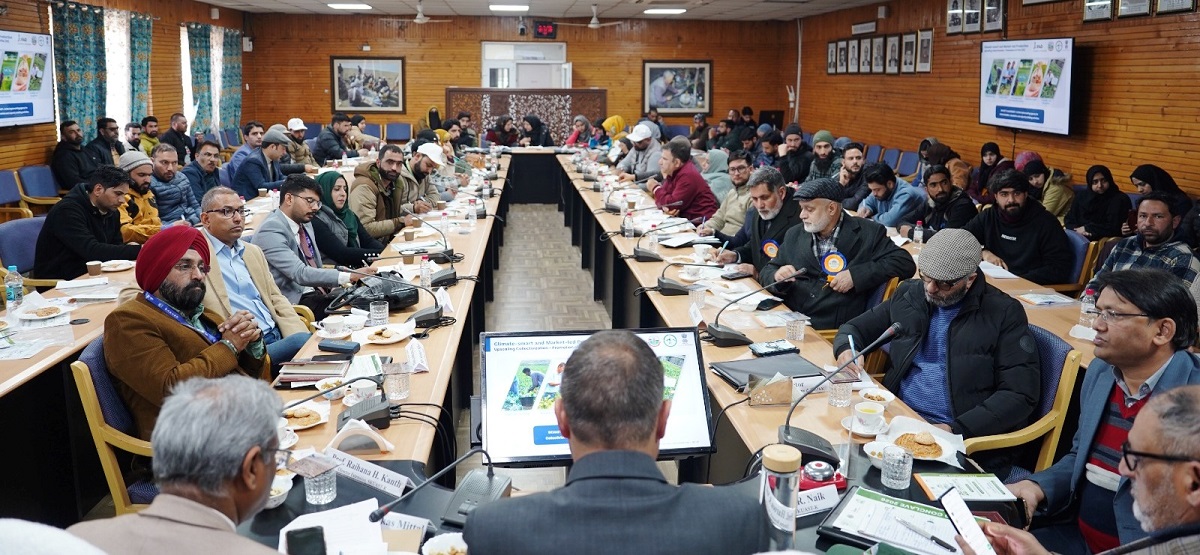
Sher-e-Kashmir University of Agricultural Sciences and Technology, Kashmir Hosts Academia–Industry Dialogue
Srinagar- Taking a significant step towards strengthening the regional economy in the face of global and local challenges, Sher-e-Kashmir University of Agricultural Sciences and Technology, Kashmir organized a groundbreaking Academia–Industry Trade Dialogue during its 11th annual Technology-cum-Trade Fair, Gon’gul 2026. The event attracted a diverse group of participants, including trade body members, industrialists, civil society representatives, academicians, and bankers, all coming together to strategize for the economic resilience and sustainability of Jammu & Kashmir.
Amidst a backdrop of geopolitical tensions and trade uncertainties, SKUAST-K spearheaded the initiative to identify practical insights for a more diversified regional economy.
Vice-Chancellor of SKUAST-K, Prof. Nazir A. Ganai, highlighted the university’s successful shift towards a Skill-Innovation-Entrepreneurship-oriented education model in alignment with NEP-2020. While universities alone may not solve regional challenges, they play a crucial role as platforms for industry experts and policymakers to collaborate on sustainable solutions. Prof. Ganai emphasized strategic partnerships with institutions like IIT Mandi, IIT Bombay, and IISc Bengaluru, underscoring the importance of ethical leadership in guiding Jammu & Kashmir towards becoming a developed region by 2047.
Prof. Farhat Shaheen outlined the objectives of the meeting, stressing the need for a collaborative approach to build a resilient ecosystem. Key issues such as tourism sector sensitivity and infrastructural deficiencies were identified, calling for a policy-driven framework to address structural gaps.
During a panel discussion moderated by Prof. F.A. Shaheen, experts addressed sector-specific challenges and proposed solutions to enhance productivity and quality to meet global standards. The discussion praised the Holistic Agriculture Development Programme (HADP) for bridging developmental gaps and emphasized the need to expand such initiatives to unlock the region’s full potential. Environmental sustainability was a focal point, with calls for the restoration of natural resources and responsible tourism practices to protect the ecosystem.
The conversation delved into necessary reforms in Health Education Policy to position Kashmir as a hub for health and education tourism, leveraging the bioeconomy. Delegates highlighted the importance of establishing strong connections to attract support for local startups from donors and high-net-worth individuals.
