
The Growing Concern Over Reservation Policy in Jammu and Kashmir
The issue of reservation in Jammu and Kashmir has transcended mere quotas and categories, shedding light on the increasing powerlessness within the political framework.
What initially began as a policy decision has evolved into a prolonged and emotionally draining public saga over the past eighteen months.
Students have been caught in a cycle of heightened hopes, prolonged delays, ambiguous communications, and public displays, with no definitive resolution in sight.
Instead of a rational, data-driven discourse on social justice and representation, the matter has transformed into a case study on governance in Jammu and Kashmir, characterized by scarce authority, unclear accountability, and a lack of transparency.
The genesis of this turmoil can be traced back to March 2024 when the Jammu and Kashmir Reservation Rules, 2005 underwent amendments. Through a series of notifications, the administration led by the Lieutenant Governor augmented reservations for Scheduled Tribes and Other Backward Classes.
This adjustment elevated the total reservation in employment opportunities and educational institutions to approximately 70 percent, leaving only a meager 30 percent of seats under the open merit category.
This sudden change came as a shock in a region where competitive examinations often serve as the primary pathway for social and economic advancement.
For many students in the general category, the apprehension did not stem from the concept of reservation itself, but from the abrupt expansion of its scope. Concerns regarding equity and fairness remained unaddressed, while opportunities dwindled almost overnight.
This transformation occurred without substantial public consultation or transparency.
As discontent burgeoned, reservation emerged as a pivotal issue in the 2024 Assembly elections.
While nearly every political faction touched upon it, it was the National Conference that resonated with numerous students by pledging to rationalize the reservation policy if it ascended to power.
The term “rationalization” held significance, signifying equilibrium rather than regression and reform rather than conflict.
Upon assuming office, the NC government instilled genuine hope among many students that relief was on the horizon.
There was a prevailing sentiment that an elected government would exhibit a keener ear to the youth’s grievances.
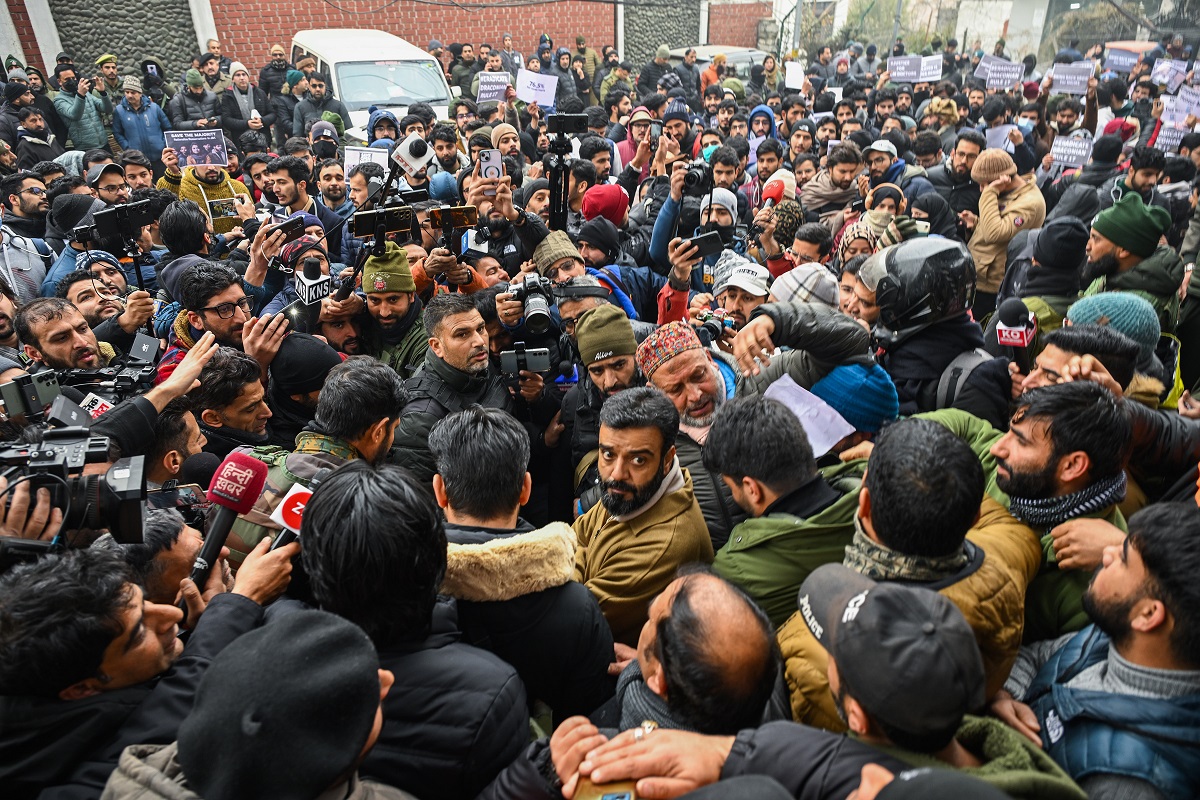
By the conclusion of 2024, with no tangible strides taken to rationalize the reservation policy, students congregated outside the Chief Minister’s residence on Gupkar Road in Srinagar, demanding action.
What set this protest apart was the participation of National Conference Member of Parliament Aga Ruhullah Mehdi, who openly sided with the students.
This instance was a rarity, witnessing an elected representative publicly aligning with demonstrators against his own party’s administration.
The visuals from Gupkar conveyed a resounding message – this was not a protest orchestrated by the opposition but a movement propelled by student apprehensions.
Subsequently, the government announced the establishment of a Cabinet Sub-Committee to evaluate the reservation policy, setting a deadline of six months for the submission of its findings.
For a brief interlude, the agitation on the streets subsided. Students remained patient, protests dwindled, and a cautious sense of optimism crept in, suggesting that perhaps the system was finally attentive.
However, in Jammu and Kashmir, waiting often translates to witnessing assurances dissipate gradually.
Months elapsed, yet no public disclosure of the report materialized. There was no synopsis, no array of recommendations, and no rationale for the delay.
The very students who were urged to wait now felt disregarded. The sentiment of betrayal intensified, not only towards the government but also towards the political mechanism as a whole.
Later, the government asserted that the Cabinet Sub-Committee had furnished its report, which received the cabinet’s endorsement. It was subsequently clarified that the dossier had been forwarded to the Lieutenant Governor for the final nod, as mandated by the prevailing administrative configuration in Jammu and Kashmir.
Even at this juncture, clarity was elusive. Those outside the bureaucratic realm remained oblivious to the report’s contents. Would open merit quotas expand, and by what extent? Which categories would undergo modifications? What dataset was utilized? These queries remained unanswered.
This silence arguably constitutes the most detrimental facet of this entire saga.
When the future of students hangs in the balance, uncertainty often inflicts more distress than adverse revelations.
Against this backdrop, Aga Ruhullah has once again called for demonstrations on December 28, urging transparency and decisive action from the government.
On the surface, the demand is entirely justified. Students are not seeking preferential treatment; they merely seek insight into the determinations that will mold their futures.
Simultaneously, there are queries concerning the direction of the protest.
Critics question why the Chief Minister is being targeted when the dossier rests with the Lieutenant Governor, and why the pressure is not being exerted where the ultimate authority lies.
These are legitimate interrogations, pointing to a deeper quandary in the modus operandi of governance in Jammu and Kashmir, where answerability is fragmented, and culpability is conveniently shifted.
Nevertheless, for students, these institutional intricacies offer scant solace. What they perceive is a youth-centric issue being volleyed between offices, while their professional pursuits remain in abeyance.
Most distressing of all is how a genuine student concern has gradually devolved into a political pawn.
There exist a handful of sagacious voices across the political spectrum who acknowledge that reservation is both indispensable and delicate, and that mishandling it can jeopardize societal trust.
Regrettably, these voices often get drowned amidst political jousting and symbolic gestures.
The debate surrounding reservation in Jammu and Kashmir does not necessitate further theatrics. It craves elucidation.
If those in positions of authority fail to recognize this, the repercussions will not be borne by politicians. It will be borne by a cohort of students who are gradually losing faith in a system meant to nurture them.
Arguably, this entire episode vividly portrays not merely a policy lapse but a profound sense of despondency within the extant political framework.
