
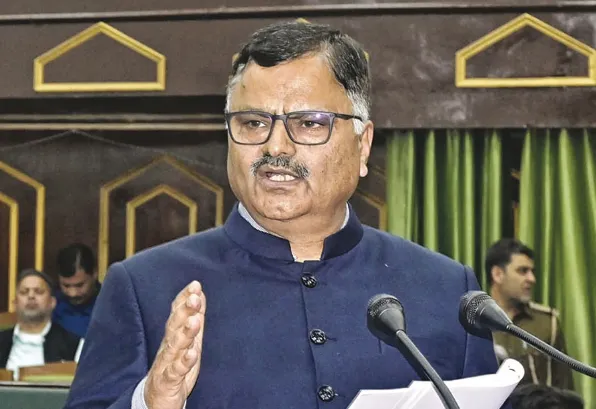
Government and Opposition MLAs Work Together to Tackle Natural Calamity
In a recent statement, Minister for Jal Shakti, Forest, Ecology, Environment, and Tribal Affairs, Javed Ahmed Rana, highlighted the collaborative efforts of the government and opposition MLAs in addressing a recent natural calamity. He praised the Chief Minister for demonstrating exemplary leadership in managing the crisis effectively.
Rana emphasized the government’s swift response to the devastating floods of August-September 2025, noting that restoration works began within 24 hours. He also mentioned the formation of a high-level inter-departmental committee to ensure water security and effective flood control for long-term sustainability.
Furthermore, Rana discussed the State Specific Action Plan (SSAP) on water, which has received draft approval from the union government. This plan, prepared under the National Water Mission with technical support from NIH Roorkee and IIT Jammu, is nearing final approval stages.
Enhanced Allocation for Forest Conservation
For the fiscal year 2026–27, an increased allocation of Rs 242 Cr has been proposed for the forest department, demonstrating a strong commitment to conservation and sustainable development. Additionally, significant progress has been made in forest demarcation, with the installation of 1.85 lakh boundary pillars and the digitization of forest boundaries using advanced technology.
Wetland conservation remains a priority, with 260 wetlands mapped using GIS and remote sensing. The revival of Wular Lake, a Ramsar site, has seen substantial progress, benefiting over 5,200 fishermen through dredging and afforestation efforts.
Wildlife Conservation and Air Quality Improvement
Rana highlighted the conservation measures taken to cover 11.5 percent of the UT’s area for wildlife protection. Over 3,002 animals have been rescued, and compensation of over Rs 214 Cr has been disbursed for human-wildlife conflict incidents. Additionally, Jammu and Kashmir continue to maintain a carbon-positive status, with significant improvements in air quality leading to a reduction in PM10 levels.
The Minister also mentioned the empowerment of local communities through the establishment of sale depots under the Sustainable Collection and Utilization of NTFP Policy. This initiative has benefited 7,100 families and generated income amounting to 792.32 lakh.
Efforts Towards Sustainable Water Supply
In the Public Health Engineering Department, the government is committed to providing drinking water to every rural household in Jammu & Kashmir through the Jal Jeevan Mission. Over 15.64 lakh households have already been provided with tap water connections, with ongoing schemes aimed at covering the remaining households.
Major water supply projects are underway to ensure uninterrupted supply to AIIMS Awantipora and AIIMS Vijaypur. These projects aim to enhance water supply infrastructure and meet the growing demand for clean water in the region.
Focus on Irrigation and Flood Control
In the Irrigation & Flood Control sector, a substantial increase in capital expenditure has been proposed for 2026–27 to bring 3.96 lakh hectares under assured irrigation. Major projects like the Shahpur Kandi Dam Project and Tawi Barrage Project are nearing completion, with significant progress reported in enhancing flood-carrying capacity and bank protection works along River Jhelum.
Efforts are also underway to implement floodplain zoning measures and execute over 1,000 irrigation and flood control works as part of the UT Capex programme.
Empowering Tribal Communities
For the Tribal Affairs Department, a focus on education, livelihood, infrastructure, and cultural preservation has been outlined for 2026–27. Initiatives like constructing transit accommodations for migratory tribes and training tribal youth as eco-guides aim to support the socio-economic development of tribal communities.
Collaborations with institutions like IIT Jammu for entrepreneurship development and strategic planning demonstrate the government’s commitment to empowering tribal populations and preserving their cultural heritage.
Overall, the Jammu and Kashmir Legislative Assembly passed grants worth millions for various departments, reflecting the government’s dedication to addressing key issues and promoting sustainable development in the region.
