
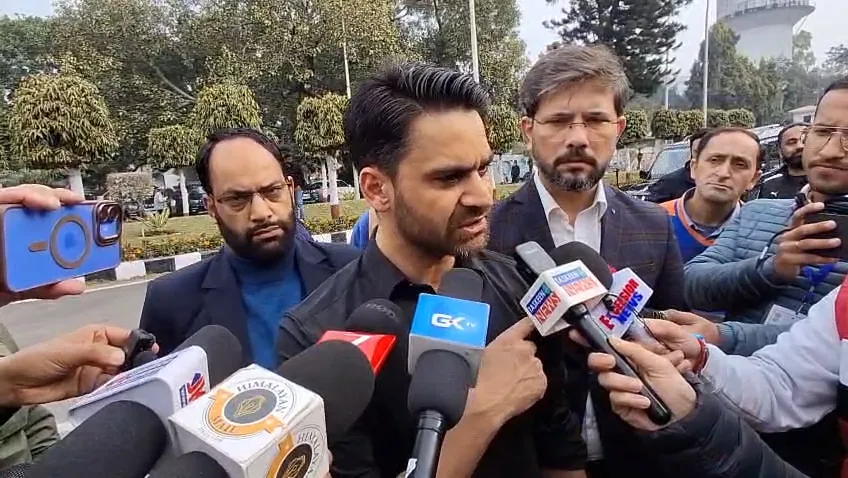
PDP MLA Raises Concerns Over Delays in AIIMS Completion in Kashmir Valley
During a recent discussion in the Assembly on grants for education, social welfare, and health, PDP MLA Waheed-ur-Rehman Parra expressed his worries about the slow progress in completing an AIIMS in the Kashmir Valley. He also highlighted various issues related to healthcare infrastructure, private clinics’ registration, and the reservation policy in Jammu and Kashmir.
Parra emphasized the importance of sectors like education, social welfare, and health for human development, stressing the urgent need for attention due to increasing demands and existing limitations.
He specifically mentioned the AIIMS Awantipora project, which serves the Pulwama-Challar belt, stating that its completion would greatly enhance healthcare services in south Kashmir and Srinagar. Despite reaching 70% completion last year, the project has not made significant progress, leading to cost escalations.
Calling for closer government monitoring of the AIIMS project, Parra believes that it could bring substantial improvements to Pulwama and benefit the entire south Kashmir region.
Additionally, Parra highlighted the lack of MRI facilities at the district hospital in Pulwama, urging for their immediate establishment to cater to the high patient influx amid staff shortages. He also called for the establishment of a community health centre (CHC) in the Khan Medical Block under centrally-sponsored schemes.
Addressing the pending permanent registration of over 3,000 private clinics in Jammu and Kashmir, Parra emphasized the importance of regularizing these clinics to support the healthcare system in areas where government facilities are insufficient.
Furthermore, Parra raised concerns about the reservation policy, pointing out the existing imbalance in opportunities where 60% of the population receives only 40% of the opportunities. He urged the J-K government to put two orders (SRO 305 and SRO 176) related to the new reservation policy on hold until the Cabinet committee report is finalized and issues regarding caste census and related metrics are resolved.
By temporarily suspending the implementation of these orders in the social welfare sector, Parra believes that public anxiety can be alleviated, and a more balanced opportunity distribution can be achieved.
