
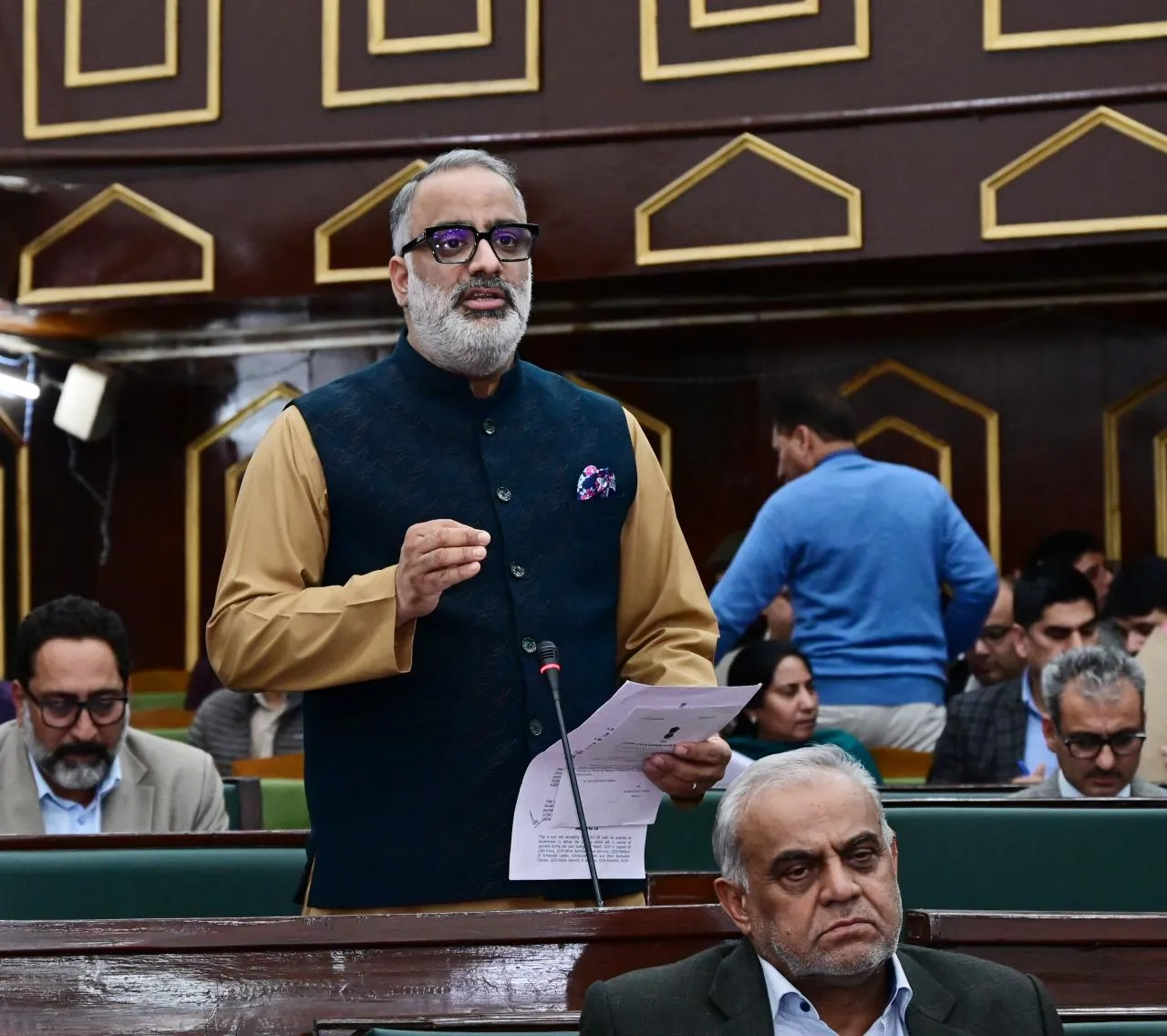
National Conference MLA Urges Restoration of Control Over Premier Public Institutions in Jammu and Kashmir
In a recent statement, National Conference leader and Hazratbal MLA, Salman Ali Sagar, advocated for the transfer of administration and control of key public institutions in Jammu and Kashmir back to the elected government. Sagar emphasized the importance of democratic accountability and direct oversight by elected representatives, rather than management by the Lieutenant Governor’s office.
During a discussion in the Jammu and Kashmir Legislative Assembly on grants for the Health, Education, and Social Welfare departments, Sagar highlighted the need to bring institutions like the Sher-i-Kashmir Institute of Medical Sciences (SKIMS) and the University of Kashmir under the purview of the popular government. He argued that the current arrangement dilutes public accountability and disconnects these vital institutions from the concerns of the general population.
Sagar stressed that elected representatives are responsible for the growth, functioning, and welfare of public institutions, emphasizing that decision-making in critical sectors should align with the needs and aspirations of the people. He proposed that restoring institutional control to the elected government would enhance transparency, responsiveness, and long-term planning in healthcare and education.
Addressing the state of social welfare infrastructure, Sagar called for a transformation in the approach towards facilities like old age homes and orphanages. He emphasized the importance of providing residents with dignity, emotional support, and active engagement, rather than mere custodial care. Sagar urged for structural and administrative reforms to make welfare institutions more vibrant and responsive to the needs of vulnerable populations.
In addition, Sagar advocated for the enhancement of financial assistance schemes for economically weaker sections, including increased scholarships for poor students and higher pensions for senior citizens. He highlighted the importance of adjusting monthly assistance to cope with inflation and rising living costs, to alleviate financial burdens on struggling households and support educational opportunities for disadvantaged youth.
Shifting focus to civic issues in Srinagar, Sagar raised concerns about the shortage of burial space in the city. He noted the inadequacy of existing graveyards and the failure of successive administrations to address the growing population’s needs. Sagar emphasized the urgent need for government intervention to establish additional burial grounds to accommodate the city’s expanding urban population.
Discussing healthcare infrastructure in Srinagar’s old city areas, Sagar highlighted the strain faced by hospitals like JLNM Hospital, Sub District Hospital Habak, and the Maternity Hospital at Zakura due to limited facilities and staffing. He called for immediate infrastructure upgrades, modern equipment, and expanded staffing to meet the increasing patient load effectively.
Sagar also emphasized the revival of the historic Maharaj Gunj Hospital and the upgradation of Gausia Hospital in Khanyar to improve healthcare services in densely populated areas. He stressed the importance of reopening Maharaj Gunj Hospital, a 150-year-old institution, to ease pressure on existing health centers and enhance access to medical treatment for local residents.
Furthermore, Sagar highlighted the need to modernize infrastructure in government-run schools to provide students with adequate classrooms, laboratories, digital learning tools, and recreational facilities. He underscored the importance of bridging the gap between private and government education systems by ensuring that public schools offer modern amenities for equitable educational opportunities.
