
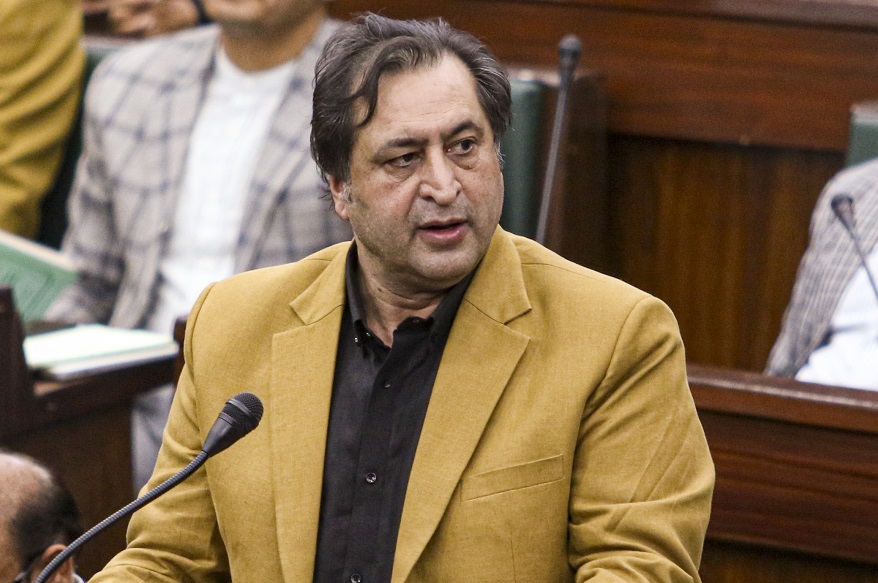
Sajad Lone Exposes National Conference and BJP’s Voting Pattern in J&K Assembly
Srinagar: Sajad Lone, the President of Jammu and Kashmir Peoples Conference and Handwara MLA, made startling revelations on Thursday regarding the voting behavior of the National Conference (NC) and the BJP during the voting on the Governor’s Address in the J&K Assembly. According to Lone, several key public issues were disregarded as these two parties jointly voted against crucial amendments.
During a press briefing, Lone shed light on the legislative process, emphasizing that amendments to the governor’s address are either accepted, withdrawn, or put to vote. He expressed disappointment over the fact that significant amendments were rejected by the NC and BJP.
One of the amendments that faced opposition sought to draw attention to the attacks on Kashmiris outside Jammu and Kashmir and the lack of visible action by authorities in other states. Lone criticized the absence of any mention regarding such incidents and questioned the lack of official response.
Furthermore, Lone highlighted that amendments related to the regularisation of daily wage workers, HDF employees, NREGA workers, and Rehbar-e-Khel employees were also turned down, indicating a lack of concern for these marginalized groups.
On the issue of employment, Lone pointed out that an amendment concerning the promise of one lakh government jobs for youth and the demand to raise the upper age limit in combined examinations from 32 to 37 years was rejected. This decision was met with disapproval by Lone, who emphasized the importance of addressing youth unemployment.
In a surprising turn of events, even an amendment proposing the establishment of a National Law University in Kashmir at Ompora, Budgam, failed to receive approval. This project, previously announced by the Chief Minister, was also disregarded by the NC and BJP.
Addressing the reservation issue, Lone highlighted the structural imbalance in government employment in Kashmir. He pointed out that despite comprising 60% of the population, Kashmiris only hold 28% of government jobs, indicating a significant deficit. Lone argued that this disparity is primarily due to reservations, suggesting that a mere 10% increase in open merit seats would not effectively address the issue.
Conclusively, Lone expressed his dismay at the voting pattern of the National Conference and BJP in the Assembly, urging the public to be aware of the decisions made by these political parties.
