
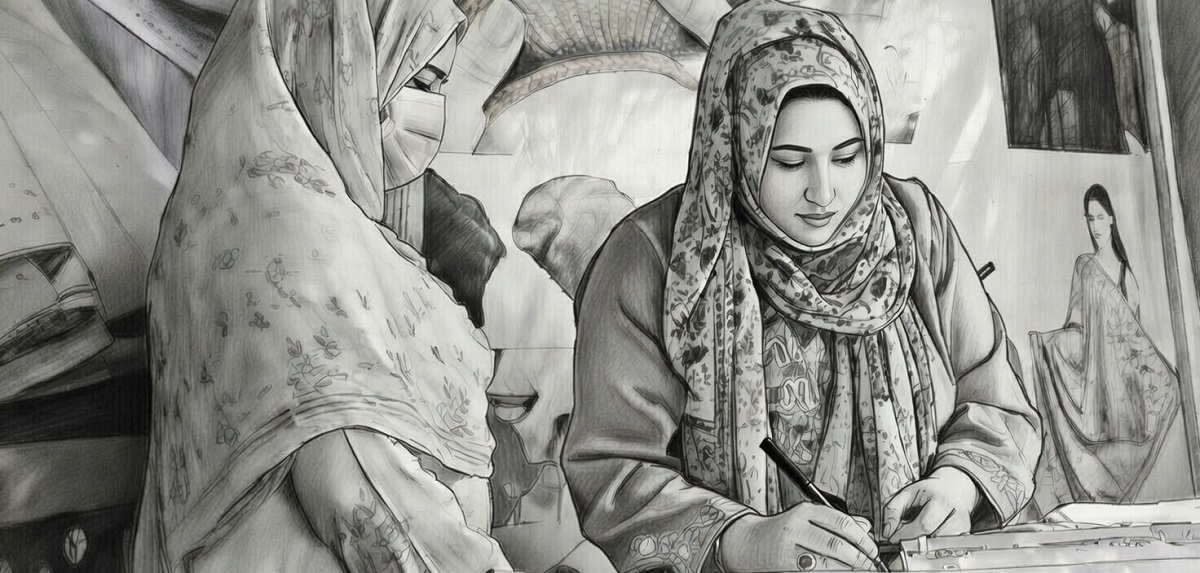
Empowering Women in Jammu and Kashmir: Redefining Leadership and Economic Growth
By Ankit Patel
Jammu and Kashmir is witnessing a significant shift as women are assuming pivotal roles that drive the economy, society, and governance.
Women are leading initiatives in various sectors such as rural livelihoods, startups, local councils, healthcare, education, and peacebuilding.
This transformation showcases the impact of women utilizing creativity, leadership, and proactiveness to translate ideas into tangible outcomes.
Rural women, in particular, are redefining their economic participation, leading to substantial changes in their communities.
Previously, the Jammu and Kashmir Rural Livelihoods Mission, Umeed, introduced the Self-Help Group model to provide women with access to banking and credit facilities. By 2025, the program had reached 66 percent of rural households across 125 blocks, supporting approximately nine lakh families.
SHG-Bank Linkage programs have significantly increased the average income per member, leading to a transformation of household activities into structured business ventures.
In a historic moment on International Women’s Day 2025, banks approved ₹100 crore in loans for SHGs in a single day, showcasing the confidence in women’s ability to manage credit and develop enterprises.
Examples like Shabnam, who turned her embroidered shawl work into a successful local business in Kupwara, and Jyoti, who used pooled savings to launch a retail and beauty venture in Mathwar, demonstrate how women are leveraging their skills to create thriving micro-enterprises.
The education sector is also witnessing a surge in innovation and opportunities for women entrepreneurs. The number of registered startups in Jammu and Kashmir grew from 237 in 2020 to 917 in 2024, with 36 percent being led by women.
These ventures blend traditional practices with modern business strategies, encompassing areas such as handicrafts, cuisine, and digital services.
During communication blockades post-2019, women-led startups displayed resilience by sustaining production, training local girls, and maintaining market connections through creative problem-solving.
Agriculture is another sector where women are spearheading modernization efforts. An entrepreneur in Balhama expanded her family’s beekeeping operations under the Holistic Agriculture Development Programme, resulting in a substantial increase in honey production and revenue.
Political participation of women has also seen a significant rise, with the three-tier Panchayati Raj system reserving 33 percent of seats for women at various levels, leading to a more active engagement of women in governance.
By 2024, women held 45.61 percent of Panchayati Raj Institution seats nationally, including in Jammu and Kashmir, where female leaders are prioritizing key areas like sanitation, healthcare, education, and water supply.
Women are not only driving economic and political initiatives but also turning personal experiences into civic action, advocating for issues that affect their communities.
Healthcare workers and teachers, predominantly women, play a crucial role in rural communities, providing essential services and expanding educational access.
Data reflects the positive changes brought about by women’s empowerment, with indicators such as declining Total Fertility Rate, increasing female literacy rates, and rising institutional births.
Digital platforms are opening up new avenues for women entrepreneurs and learners, paving the way for further growth and development.
Policy and governance measures are supporting and reinforcing the progress led by women, as evident in the NITI Aayog SDG India Index 2023-24 and the 2026 budget that emphasize gender equality and economic empowerment.
Women in Jammu and Kashmir are at the forefront of transforming ideas into action, driving economic growth, and shaping a future filled with opportunities and leadership.
Their remarkable efforts are not only strengthening families and communities but also laying the foundation for a more inclusive and prosperous society.
The author studies at the Indian Institute of Mass Communication, Jammu. He can be reached at [email protected].
Pullout: Women in Jammu and Kashmir transform ideas into action. They manage credit, build enterprises, lead councils, advocate for communities, and guide the next generation. Each initiative strengthens families, communities, and local economies. Their work illustrates a future shaped by vision, enterprise, and leadership, where opportunity grows through creativity and initiative.
