
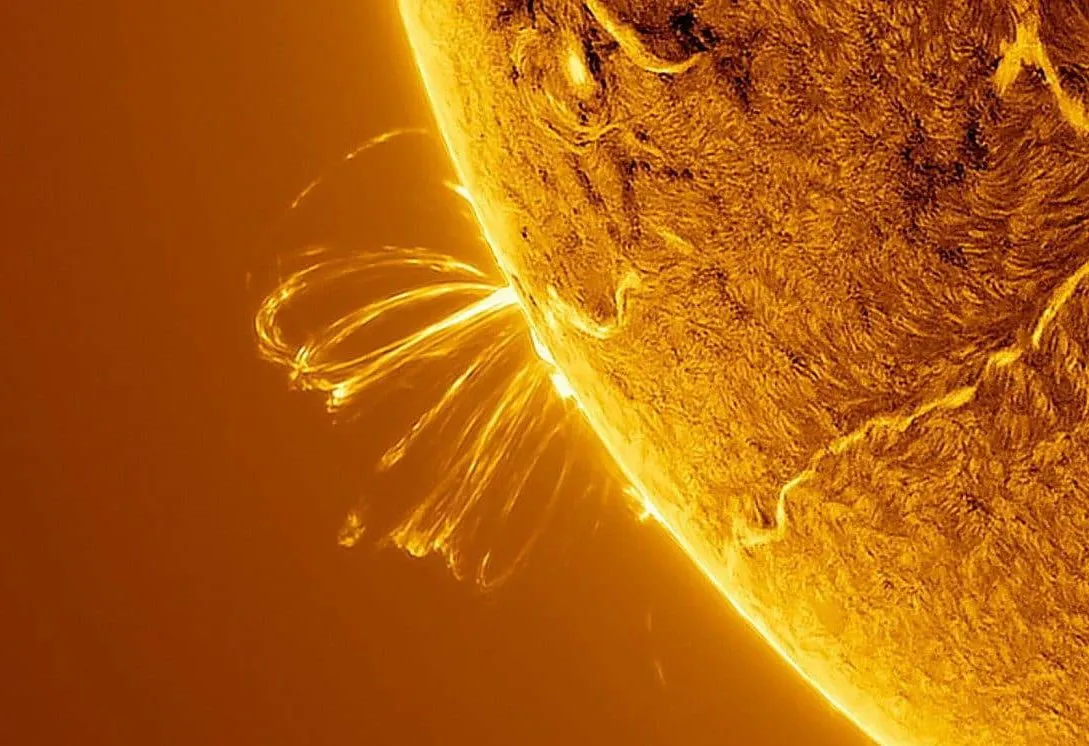
Solar Flares Alert: ISRO Monitors Satellites Amid Solar Storm Threat Space agencies worldwide, including the Indian Space Research Organisation (ISRO), have issued warnings about potential disruptions caused by powerful solar flares from the Sun. These solar flares have the potential to lead to radio blackouts, affecting communications, navigation systems, and satellite operations. ISRO officials have confirmed that more than fifty operational Indian satellites are under close observation due to the increased solar activity, as reported by NDTV.
Anil Kumar, Director of ISRO’s Telemetry, Tracking, and Command Network (ISTRAC), stated that ground stations have already issued alerts to mission control centers. Contingency plans are in place to address any anomalies promptly.
According to Kumar, “There is a strong possibility of radio blackouts. All ISRO satellites are being closely monitored, and any communication loss will be promptly addressed.”
When directed towards Earth, powerful solar storms can potentially damage satellites, disrupt television signals, affect radars, and impact power grids.
The Sun’s Unrest: A Closer Look
The recent surge in solar activity originated from an intense sunspot cluster known as Active Region 14366. This region has experienced multiple eruptions, including four significant solar flares, with an X8.1-class flare being the most potent one in 2026 so far.
NASA confirmed that these flares peaked between February 1 and February 2, with the strongest eruption occurring on February 1. These events, captured by NASA’s Solar Dynamics Observatory, rank among the top 20 most powerful flares recorded since satellite monitoring began in 1996.
The ongoing solar storm activity is part of the Sun’s cycle of intense activity, occurring approximately every 11 years.
Impact on Earth and India
Intense solar flares release bursts of electromagnetic radiation that reach Earth rapidly. While not directly harmful to humans, they can disrupt the ionosphere, Earth’s upper electrically charged atmosphere. This disruption can cause radio communication blackouts, navigation signal disturbances, increased radiation exposure for satellites, and risks to aviation near the poles.
Professor Dibyendu Nandi, a solar astrophysicist at the Centre of Excellence in Space Sciences India, noted that the recent solar activity was anticipated. Indian scientists had issued alerts based on their analyses ahead of the heightened activity.
Monitoring the Solar Storm
Despite the intense solar flaring, Earth has not yet experienced a severe Earth-directed coronal mass ejection (CME). While a weak CME is predicted, experts remain vigilant for potential larger impacts. The proximity of the active region to the Sun-Earth line raises concerns about a stronger impact possibility.
India’s Preparedness: Aditya-L1 Mission
India’s Aditya-L1 solar observatory, positioned at the Earth-Sun L1 Lagrange point, plays a crucial role in monitoring solar activity. This observatory provides real-time data on solar radiation, magnetic fields, and energetic particles, aiding in issuing early warnings to safeguard space infrastructure.
India’s commitment to solar science is further demonstrated by the planned National Large Solar Telescope, aimed at better understanding solar behavior and mitigating potential solar storms’ impacts.
The ongoing solar storm, while not posing immediate catastrophic threats, underscores the Sun’s unpredictability. As the active region continues its rotation, vigilance remains key to anticipating any future solar outbursts.
