
The US State Department Reveals Gifts from Indian Leaders to US Officials
The US State Department recently disclosed a detailed list of gifts exchanged between Indian Prime Minister Narendra Modi and other Indian government officials with US leaders, including former President Joe Biden.
The Office of the Chief of Protocol at the Department of State provided an extensive compilation of “gifts received from foreign government sources” as mandated by law. This list encompasses both tangible gifts and travel expenses exceeding a minimal value, set at USD 480.00 for the year 2024.
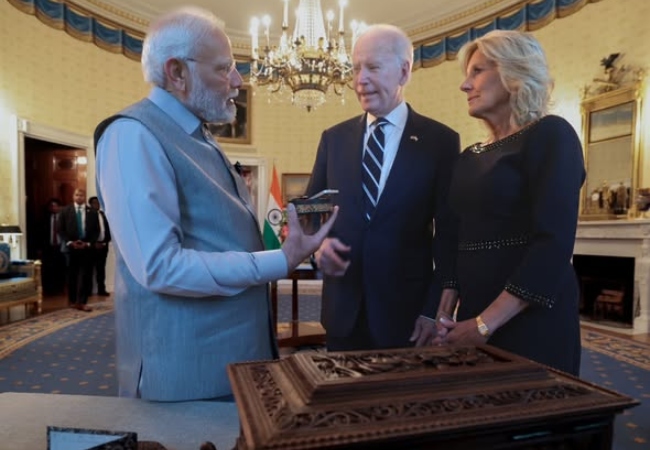
Among the notable gifts mentioned was a set consisting of a Wood Chest, Scarf, Saffron with Jar, and Wood Box for Tea, presented by Modi to Biden on September 10, 2023, valued at USD 562. The non-perishable items were archived at the US National Archives, while perishable gifts like saffron and tea were disposed of according to US Secret Service guidelines.
During the G20 Leaders’ Summit in New Delhi in September 2023, Biden also received a Sterling Silver Metal Train Set from Modi, estimated at USD 7,750. This gift was similarly transferred to the National Archives.
Notably, former First Lady Jill Biden was gifted a luxurious Pashmina Shawl by Modi in October 2024, valued at USD 2,969, which was also archived. National Security Advisor Ajit Doval presented a Kashmir Pashmina Scarf with Box to Jacob Sullivan, estimated at USD 599, which was transferred to the General Services Administration (GSA).
Another significant gift was a Lord Krishna Raas Leela Silver Box received by former Vice President Kamala Harris from Modi, valued at $1,330 and transferred to NARA. Harris’ husband, Douglas Emhoff, also received cufflinks from Modi, estimated at $585.65, which were archived as well.
Defence Minister Rajnath Singh gifted a Shiva Nataraja Bronze Statue to former Secretary of Defense Lloyd Austin, with an estimated value of USD 3,700, pending transfer to GSA.
The report also highlighted that the acceptance of these gifts was justified by the potential embarrassment that non-acceptance could cause to both the donor and the United States.
