
India and EU Conclude Historic Free Trade Agreement
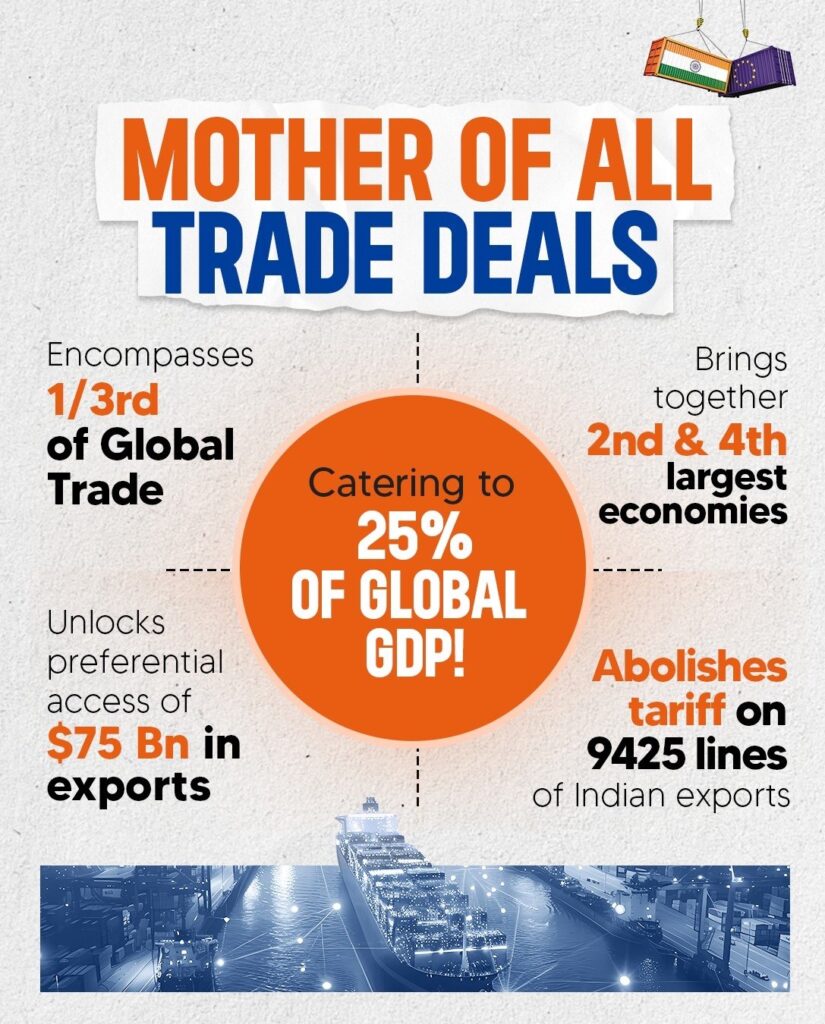
New Delhi- India and the European Union have announced the successful conclusion of negotiations for a groundbreaking free trade agreement. This deal, often referred to as the ‘mother of all deals’, will grant duty-free access to 93% of Indian shipments in the 27-nation bloc, while also reducing the cost of importing luxury cars and wines from the EU.
The agreement, reached after nearly two decades of negotiations, will establish a market comprising approximately 2 billion people, encompassing the world’s fourth-largest economy, India, and the second-largest economic bloc, the EU.
Together, India and the EU represent 25% of the global GDP and one-third of international trade, amounting to around USD 11 trillion out of USD 33 trillion.
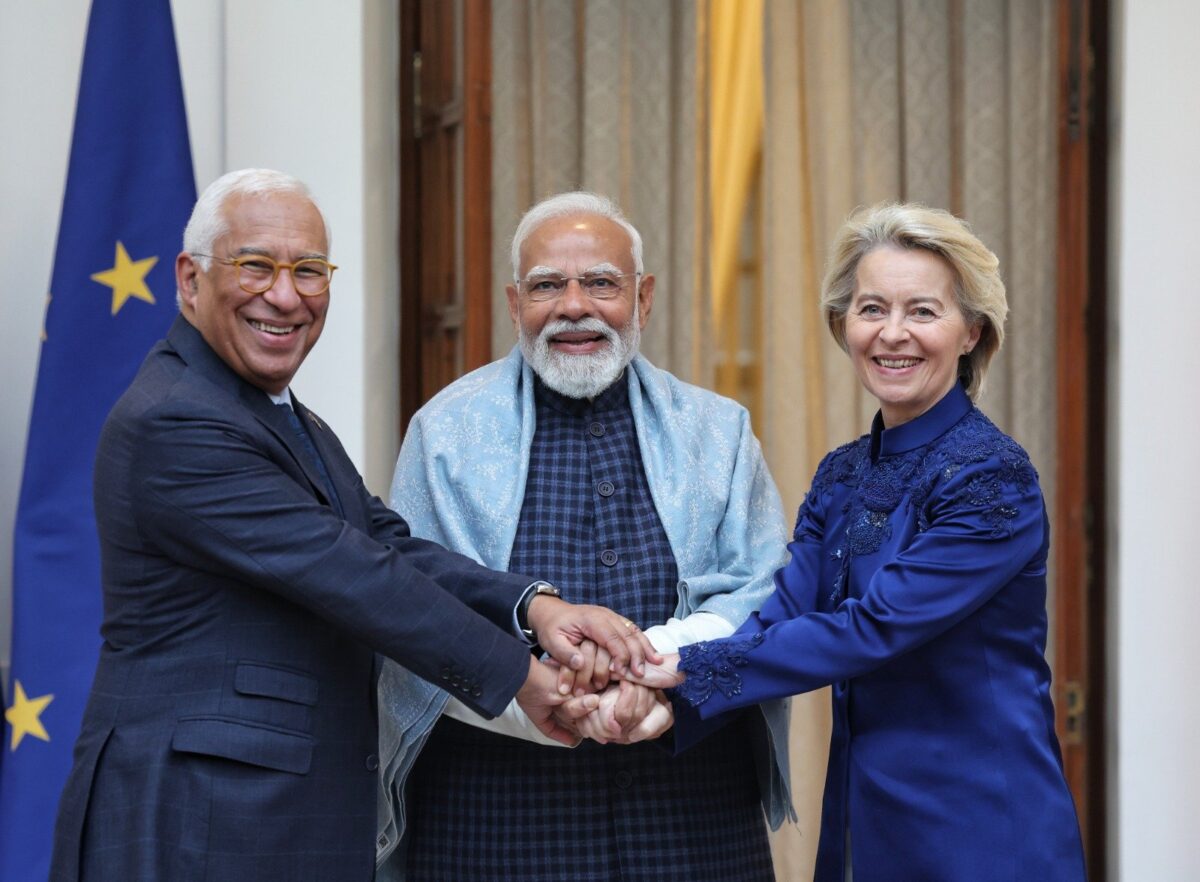
Following high-level discussions with top EU leaders Ursula von der Leyen and Antonio Costa, Prime Minister Narendra Modi declared that India has finalized its largest free trade agreement to date with the European Union.
“This is more than just a trade agreement. It signifies a new framework for mutual prosperity,” Modi emphasized.
According to Commerce and Industry Minister Piyush Goyal, this deal offers unparalleled market access for over 99% of India’s exports by value.
The pact represents a strategic milestone in India’s global trade interactions, unlocking vast opportunities in the USD 20 trillion EU market for 1.4 billion individuals, he added.
The formal signing of the agreement is scheduled to take place within 5-7 months, with the anticipated implementation in 2026 itself.
Once in effect, nearly all Indian goods (over 93%) will receive zero-duty access in the European Union, with the remaining over 6% benefiting from tariff reductions and quota-based duty concessions, notably for items like automobiles.
It is anticipated that the agreement will be signed later this year and put into practice in early 2027.
The EU’s average tariffs on Indian goods are currently around 3.8%, set to be reduced to 0.1% under this deal.
While some sectors face high duties, such as marine, chemicals, plastics, leather, textiles, gems, jewelry, and more, the EU will eliminate duties for India on these items.
Conversely, the EU will achieve duty-free access for over 90% of its goods over a ten-year period in India, while India will eliminate duties on only 30% of European goods upon the agreement’s implementation.
Key EU goods set to benefit from duty concessions include automobiles, wines, spirits, beer, olive oil, fruits, processed foods, meats, and more, currently subject to duties ranging from 33% to 150%.
Imported car prices from Europe are expected to decrease significantly with India agreeing to gradually reduce duties to 10% from the current 110% for 2.5 lakh vehicles annually, exceeding the offer made to the UK.
Following the India-EU FTA, tariffs on cars will progressively decrease from 110% to 10% with a quota of 2,50,000 vehicles per year. In 2024, Europe exported motor vehicles worth 1.6 billion euros to India.
Regarding the Carbon Border Adjustment Mechanism (CBAM), no specific concessions have been granted to India under the pact. However, any relaxations provided by the EU to other countries under the CBAM provisions will automatically extend to Indian exporters.
The announcement of this agreement comes at a critical juncture as India faces steep tariffs imposed by the US, while the EU confronts potential tariffs from the Donald Trump administration related to the Greenland issue.
With the EU becoming India’s 22nd FTA partner, the NDA government has significantly expanded its trade agreements since 2014, forging deals with Mauritius, the UAE, the UK, EFTA, Oman, and Australia, with upcoming agreements with New Zealand.
