
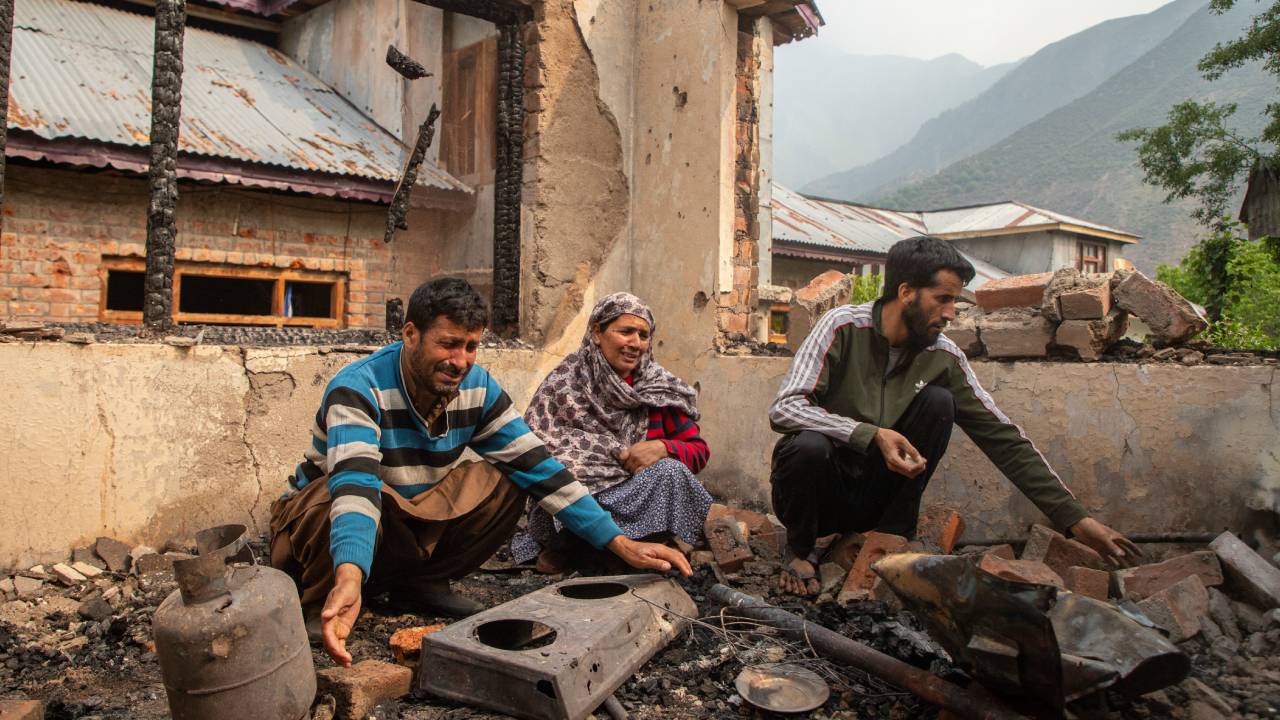
Massacre of 26 innocents in an off-track Pahalgam meadow, India and Pakistan are engaged in a confrontation that is gradually inching towards a war unless diplomacy takes over, reports Syed Shadab Ali Gillani
Ibrahim is a self-made entrepreneur who shuttles between Srinagar and Jammu almost twice a month. May 8, evening, he was driving home in the Sunjwan belt when the scare started. As he parked his vehicle, the first blast took place.
“I thought it (war) had finally begun,” Ibrahim said, while driving with some of his colleagues to Srinagar, a day later. “The first thing I thought was that death is basic to war and life as well, so why should I die unclean. I quickly had a bath.”
Minutes later, Ibrahim said he went up to the top floor and watched the skies that had converted into an amphitheatre. “I could not understand it much. What I saw were huge flares of balls hitting each other with bangs. The show was there for a few minutes, and then things were back to normal.”
The spectacle is the new normalcy in the erstwhile Jammu and Kashmir state. In Jammu, after protracted hours of blackout, as was the case in the rest of north India, people did not sleep at all. Some were on the roads for most of the night, smoking and shouting. Those in their bedrooms were awake but unable to sleep. “It is hell,” a resident of Akhnoor, a major town not far away from the International Border, said. “I know there were no losses but the spectacle that was displayed in the dead of the night indicates that things are very scary.”
Soon after the blasts were heard and the sirens were on, the younger lot rushed to the top floors to watch the happening. “This is a new generation,” Amit Kumar said. “They have no idea what the wars are all about. They have heard of wars but not seen one. Most of the education that they get about wars comes from the TV, and that is the glamour of it and not the devastation that it brings along.”
Barring the Sino-Indian conflict, all the wars that India fought were directly or indirectly linked to Jammu to Kashmir. Even the Chinese conflict emanated from a crisis in Ladakh, part of the erstwhile state of Jammu and Kashmir. While most of the wars were fought traditionally, it was the Kargil conflict in 1999 that was perhaps the first ‘war’, which was broadcast live, to a larger extent, by the TV into the people’s bedrooms. It was fought over nude peaks in Ladakh. The one that seems to be loading now, if no quick de-escalation is taking place, could be the most dangerous modern war between the two countries. On TV screens, it looks like a video game but the fact is that it could get worse.
Panic Everywhere
“What we could see and know is that there was a barrage of rockets that crossed the border but exploded mid-air,” JKNC’s senior leader and former minister, Ajay Kumar Sadhotra, said. “There was no loss of life or damage to the property but the scare was too huge.”
Within minutes, the migration started. “People who have witnessed the devastation previously are scared,” Sadhotra said. “The migrations started during the night from Akhnoor, Suchetgarh, Samba, Madh and many other places which have been vulnerable in the past.”
“My dad and mom had reached Jammu late in the afternoon, and they were cleaning the home when the blasts started,” a young Mehjoor Nagar girl, whose family lives between Srinagar and Jammu, said. “They had not completed that the scare forced them to live in a bunker sort of a thing that we had constructed. Initially, it was impossible to talk to them. When I finally managed around midnight, they were busy cooking their meals.”
Kashmir Scene
Part of Kashmir always lives in Jammu. Within minutes after the blasts were heard in Jammu, Srinagar got into quick panic mode. The traffic started thinning, and the roads got deserted. The lights went off for some time, and that added to the panic. The vast cluster of settlements around the strategic Srinagar Airport was groping in the dark for most of the night.
“I had my relatives in a Jammu hostel crying till midnight,” one Srinagar-based reporter said. “It was much later in the night, and I sent another of my relatives to get her home.”
Ibrahim had decided to stay put in Jammu but his family in Srinagar remained on the phone for most of the nine. During the wee hours, he finally decided to take the risk of driving home despite the highway not being in good shape.
After living a few years of peace, Kashmir is gradually falling back into a crisis. The April 22 massacre of visitors in the Baisaran meadow of Pahalgam, however, has not changed Kashmir alone. It has brought India and Pakistan to the brink of war. Though diplomacy is working overtime but seemingly things are yet to reach a stage where de-escalation could be visible.
The First Round
The first round of the crisis was over during the night of May 6 and 7, when India mounted a rain of missile attacks hitting select targets within the Pakistani part of Kashmir and the mainland.
The strikes were executed at 1:44 am and involved the use of precision-guided stand-off weapons, drones and advanced munitions.
Officials in a briefing in Delhi claimed to have killed “more than 70 terrorists” in a calibrated military response carried out under Operation Sindoor, a name chosen personally by Prime Minister Narendra Modi. The targets were facilities run and managed by Jaish-e-Mohammed (JeM) and Lashkar-e-Taiba’s (LeT), two militant outfits banned in India. The strikes were described as a “measured, proportionate and responsible” act of self-defence by Foreign Secretary Vikram Misri. The operation aimed to deter and preempt further cross-border attacks based on intelligence indicating imminent threats.
Operation Sindoor, named after the vermilion worn by Hindu married women, was seen as a symbolic tribute to the women widowed in the Pahalgam massacre. The strikes hit targets in Bahawalpur, Muridke, Kotli, Muzaffarabad, Sialkot, Barnala, ShawaiNalla, and Markaz Abbas in Kotli. The operation caused massive explosions in Muzaffarabad and led to blackouts and panic in the region.
Indian officials celebrated the success of the operation, with Defence Minister Rajnath Singh and other ministers expressing their support. The Pakistani leadership called it an “act of war” and promised a “befitting reply,” claiming civilian casualties. In response, the Pakistan Air Force scrambled jets and engaged in intense shelling along the Line of Control, resulting in casualties on both sides.
Operation Sindoor marked the first time in over five decades that the Indian military struck deep inside Pakistan’s Punjab province, a significant escalation in military engagement between the two countries. The operation showcased India’s aerial strike capabilities, utilizing high-precision weapon systems like SCALP cruise missiles and HAMMER precision-guided bombs integrated with Rafale fighter jets.
In a second round of strikes, the Indian Air Force targeted Pakistani air defence infrastructure, including a key installation in Lahore, in response to Pakistan’s failed attempt to target Indian military sites using drones and missiles. The strikes were part of Operation Sindoor and were described as a calibrated and proportionate response to the Pakistani aggression. India’s advanced air defence systems were activated to intercept and neutralize the incoming threats.
Recovered debris from Pakistani drones and missiles has been found in several Indian cities, providing further evidence of cross-border aggression. The debris is currently being analyzed for more information.
Following this aggression, India swiftly retaliated by deploying Israeli-made HARPY loitering munitions, specifically designed for SEAD missions. These drones autonomously targeted critical air defense radars in Pakistani territory, neutralizing the radar system in Lahore. The MoD stated that any further attacks on Indian military assets would be met with a fitting response.
In response to India’s actions, Pakistan fired missiles and projectiles towards various locations in India, including Jammu and Udhampur. However, all these projectiles were intercepted and destroyed midair.
The defense forces in India have significantly enhanced their capabilities over the past decade, as highlighted in formal and informal briefings by top government officials in Delhi.
The escalation continued as both countries struck key military installations. Srinagar experienced missile attacks, damaging houses and leaving debris in the Dal Lake. Pakistani fighter aircraft and drones violated Indian airspace, launching missiles at IAF infrastructure in Punjab. In response, key military sites in Pakistan were targeted, including radar and aviation installations.
Efforts to de-escalate tensions included diplomatic moves by Iranian Foreign Minister Abbas Araghchi, who visited both Islamabad and New Delhi to offer Iran’s assistance in easing the situation. Saudi Arabia and Russia also expressed concerns over the escalating confrontation and urged both nations to show restraint and resolve the issue through diplomatic means.
Amidst escalating tensions between India and Pakistan following the Pahalgam massacre, Maria Zakharova referenced the Simla Agreement of 1972 and the Lahore Declaration of 1999 as crucial frameworks for de-escalation and resolution. She emphasized the need for a political and diplomatic solution in the aftermath of the tragic event.
The United Nations Security Council convened a closed-door emergency session on May 5, at the request of Pakistan, to address the growing security concerns between the two nuclear-armed nations. The discussion centered on the deteriorating situation and the potential for further escalation.
UN Assistant Secretary-General Khaled Mohamed Khiari briefed Council members on the crisis, highlighting India’s military actions across the Line of Control and the broader implications for the region. UN Secretary-General António Guterres condemned the Pahalgam attack and urged both countries to prioritize dialogue, emphasizing that a military solution was not the answer.
While some Council members questioned Pakistan on its ties to armed groups and recent missile tests, the session concluded without a resolution or official statement.
In contrast, the United States adopted a cautious approach, with Vice-President J D Vance ruling out direct intervention and emphasizing the importance of restraint. He acknowledged the serious risk of escalation but stated that Washington’s role was limited to encouraging dialogue and de-escalation.
US Secretary of State Marco Rubio engaged in diplomatic outreach, speaking separately with Indian Foreign Minister S Jaishankar and Pakistani leader Shehbaz Sharif. Rubio expressed support for India’s counterterrorism efforts and urged both countries to establish direct lines of communication to prevent further conflict.
Despite maintaining a hands-off military approach, the US remained committed to preventing a prolonged or nuclear confrontation, striking a balance between strategic neutrality and counterterror cooperation. Rubio’s “shuttle diplomacy” efforts eventually led to President Donald Trump announcing a cease-fire.
However, shortly after the ceasefire announcement, explosions were reported across Kashmir and Jammu, leaving many uncertain about the situation. The Jammu and Kashmir Chief Minister expressed confusion on social media, highlighting the volatile nature of the region.
Overall, the international community’s response to the India-Pakistan crisis underscored the importance of dialogue, restraint, and diplomatic efforts to prevent further escalation and promote peace in the region.
