
The Plight of Pakistani Wives in Kashmir: A Heartbreaking Tale of Separation
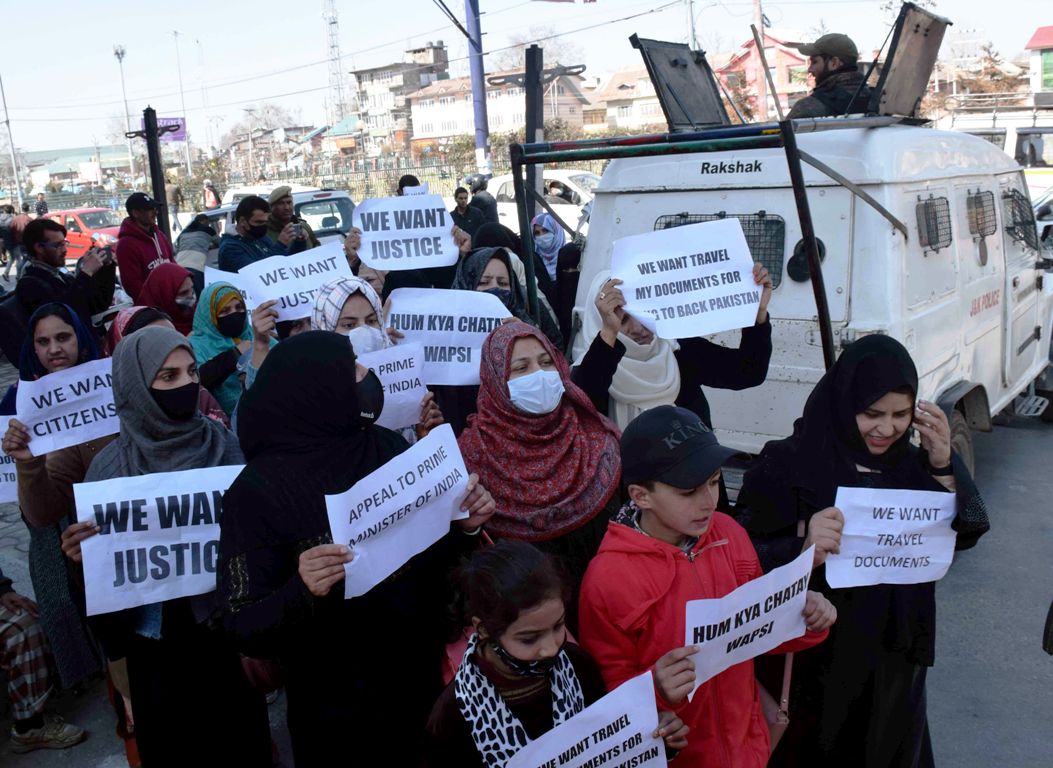
Leaving their homeland to seek a better life, numerous women followed their husbands to Kashmir under a government-sponsored rehabilitation program. However, after enduring years of struggle for citizenship rights, a cruel reality unfolded, leading to their potential separation once again, as reported by Humaira Nabi.
A sense of dread grips Mehar, a 40-year-old woman residing in north Kashmir’s Baramulla. As a mother of three, she lives in constant fear of being separated from the family she has nurtured and cherished for over a decade.
Hailing from Karachi, Mehar tied the knot with a man from Baramulla and relocated to Kashmir in 2014 under a government initiative introduced in 2010. However, following a tragic attack in Pahalgam on April 22, 2025, which led to the decision to deport Pakistani nationals, her future hangs precariously in the balance.
“Every night, I kiss my children goodnight, unsure if I’ll be there when they wake up,” she laments.
Mehar is just one of nearly 400 women who migrated to Kashmir after 2010 under a rehabilitation scheme targeting former militants who had crossed the border. This policy permitted those who had renounced violence to return to their homeland along with their Pakistani wives and children.
Official records reveal that out of the 4,587 Kashmiri men who had relocated to Pakistan between 1989 and 2009, only 489 availed of this opportunity to return, often via Nepal. Many, like Mehar’s husband, brought along their families—wives and children who now total around 3,000 in the Valley.
However, the brutal Pahalgam incident sent shockwaves through the region, throwing all such families into sudden fear and uncertainty.
Bidding Farewell
The deportations triggered profound anguish after years of peaceful coexistence. A widely circulated video captured the poignant moment when 60-year-old teacher Sageer Fatima in Rajouri bid farewell to her school and the community. Having lived in India for 43 years since her arrival in 1982 with her mother and sister Zameer, Sageer married in Shahdra Sharif village of Thanamandi.
Now, alongside her 65-year-old paralyzed and heart disease-stricken sister Zameer, she faced the prospect of being sent back to Pakistan, a place where they feel estranged.
Their story is not an isolated one. Abdul Waheed Bhat, an elderly individual who had resided in India since 1980, passed away from a heart attack on April 30, 2025, inside a bus near the Attari-Wagah border during the deportation process. Aged around 80 and paralyzed, Bhat had no family by his side as officials processed his paperwork. He breathed his last before crossing that final threshold, with his remains later being transported to the Civil Hospital in Amritsar.
Legal Quagmire
The deportations have been marred by chaos and inconsistency. Iftikhar Ali, a constable in the Jammu and Kashmir Police, witnessed the departure of his eight siblings—five sisters and three brothers—to the Attari border from Poonch district. Born in Pakistan after his parents relocated there in 1965, Ali returned with his family to Salwah village in Mendhar in 1983. Now 45, with 27 years of police service under his belt and currently stationed at Katra, his family, despite owning 17 acres of land and a house, faced deportation following a notice from the Poonch Deputy Commissioner on April 26, 2025.

Ali contested the order in the Jammu & Kashmir and Ladakh High Court, asserting that he and his siblings were Indian citizens by birth. The court intervened and issued an interim stay in his favor.
Minal Khan, a Pakistani woman married to CRPF officer Munir Khan, faced deportation a month after her arrival in India. The couple, who met online and solemnized their marriage virtually in May 2024, witnessed Minal’s arrival in India on a short-term visa in March 2025, which expired on March 22. While her application for a long-term visa was pending, the deportation order was issued. She boarded a bus headed for Attari, but her lawyer, Ankur Sharma, secured a last-minute court stay, enabling her to return to Jammu on May 1, 2025.
Outcry for Compassion
The deportations have elicited widespread outrage. Former Chief Minister Mehbooba Mufti advocated for a “compassionate approach,” cautioning against the “profound emotional and physical distress” inflicted on families who “have no other home.”
Senior CPIM leader and Kulgam lawmaker, Mohammad Yousuf Tarigami, decried the deportations as “inhumane,” highlighting how these women “have established lives here, raising families and living harmoniously.” MLA Sheikh Khursheed argued that such actions “alienate the innocent and bolster the enemy’s narrative.”
The magnitude of the situation is staggering: over 30 Pakistani nationals have been repatriated from Jammu and Kashmir, including 59 from the Valley—36 from Srinagar, nine each from Baramulla and Kupwara, four from Budgam, and two from Shopian. In Jammu, 11 individuals were sent back from Poonch, eight from Rajouri, and four from Jammu district. However, some, like Sara Khan from Budhal, returned after Pakistan rejected them, with her newborn just two weeks old.
A Life Hanging in the Balance
Shameema Akhtar, the mother of Shaurya Chakra recipient Mudasir Sheikh, narrowly evaded deportation after an erroneous notice was issued. Her son, an SPO, lost his life during a counterinsurgency operation in 2022, yet her roots momentarily put her in jeopardy. “We deserve to live in India,” her son Basit asserted to The Print. “My brother sacrificed himself for this nation.”
Dilshada Begum, a widow from Muzaffarabad, grapples with a similar nightmare. Having settled in Kashmir in 2012, she raised five children following her husband’s demise, with one of them now married with a child. “Sending me back would be akin to ripping me away from my very soul,” she expressed to ETV Bharat.
